
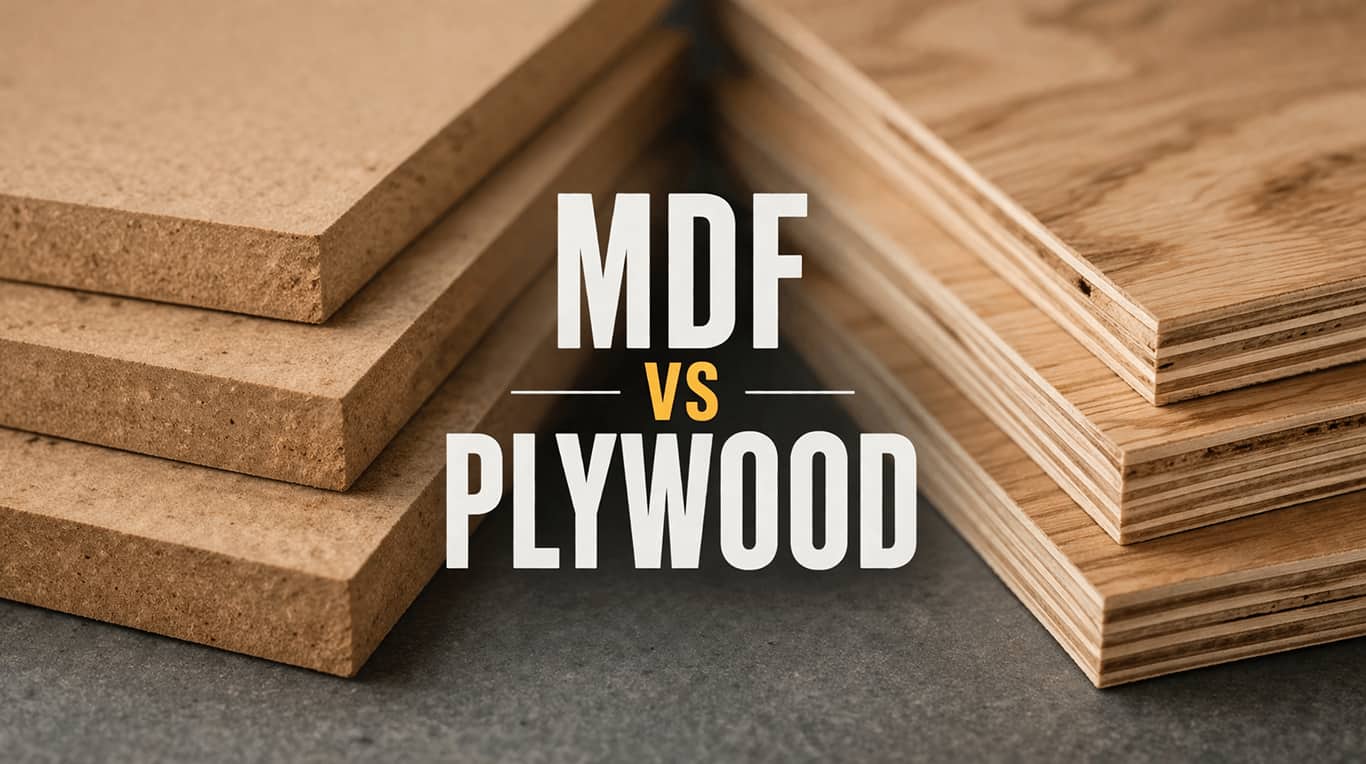
When you are planning a CNC carving project, one of the first decisions you face is choosing the right board material. MDF and plywood are both widely used across residential and commercial interiors in India, but they behave very differently under a CNC router or laser.
To ensure you get the perfect finish, Eish CNC Designs provides professional CNC laser cutting services in Indore for a variety of wood and board materials. Making the wrong choice can cost you finishing time, material waste and visual quality. This guide breaks down MDF vs. plywood for CNC carving in detail so you can walk into your next project with complete confidence.
What Is MDF and Why Is It Used for CNC Carving
MDF stands for Medium Density Fibreboard. It is manufactured by compressing fine wood fibres, resin and wax under high heat and pressure into a dense, uniform board. The result is a surface that is completely smooth, free of grain and consistent in density from edge to edge.
These properties make MDF CNC cutting exceptionally clean and predictable. The CNC router moves through MDF without encountering grain direction changes or knots, so fine detail stays sharp and consistent across the entire panel. Laser cutting on MDF produces equally clean results with sealed edges that need minimal finishing before painting or laminating.
At Eish CNC Designs, our MDF CNC cutting services are used extensively for decorative jali panels, mandir back panels, ceiling designs, partition screens and cabinet shutters. The smooth surface of MDF takes paint, lacquer and laminate beautifully, making it the first choice wherever a clean, fine finish is needed for custom interior projects.
What Is Plywood and Why Is It Used for CNC Carving
Plywood is built from multiple thin layers of wood veneer bonded together with the grain of each layer running perpendicular to the one above it. This cross-grain construction gives plywood its well-known strength and dimensional stability.
Plywood CNC cutting is well-suited to structural applications where the finished piece needs to bear load or resist moisture better than MDF can. Furniture carcasses, wardrobe frames, shelving, partition substrates and box construction all favour plywood because of its strength-to-weight ratio. Laser cutting plywood is also popular for decorative panels and box designs, particularly in 3mm and 5mm thicknesses, where the natural wood grain adds warmth and character to the finished piece.
For projects where structural strength matters alongside precision cutting, plywood is the dependable choice. At Eish CNC Designs, plywood CNC work is carried out alongside full wood carving services, ensuring every CNC on wood project achieves both durability and high-end aesthetic appeal.
MDF vs Plywood for CNC Carving: The Key Differences
Understanding these materials side by side makes your decision straightforward.
- Surface quality: MDF has a perfectly smooth, grain-free surface that produces sharp, clean edges on CNC routed and laser-cut work. Plywood has a natural grain that adds character but can cause slight variation in cut edges depending on the veneer quality and layer alignment.
- Precision and fine detail: MDF is the superior choice for intricate CNC carving work such as jali patterns, Ganesh panels, decorative borders and complex geometric cutwork. The uniform density allows the router to hold tight tolerances through every part of the design. Plywood handles moderate detail well but is not the preferred material for very fine cutwork.
- Structural strength: Plywood is significantly stronger and more impact-resistant than MDF. Where a panel needs to carry weight, withstand humidity or be fixed with screws repeatedly, plywood is the better performer. MDF is comparatively brittle at edges and can absorb moisture if left unsealed.
- Weight: MDF is heavier than plywood of the same thickness. For ceiling panels and large wall installations, this weight difference is worth considering alongside the fixing method and substrate strength.
- Cost: MDF is generally more affordable than good quality plywood, making it the economical choice for decorative and non-structural applications where large quantities of CNC cut panels are needed.
- Finishing: MDF accepts paint and laminate uniformly across the whole surface with no grain bleeding through. Plywood can show grain through certain paint finishes, which is desirable in some design contexts but requires careful specification.
When to Choose MDF for Your CNC Project in Indore?
Choose MDF CNC cutting when your project requires fine decorative detail, a perfectly smooth painted or laminated finish, or when cost efficiency matters on large decorative runs. Ideal applications include laser-cut MDF jali ceiling panels, mandir back panels, decorative room dividers, kitchen cabinet shutters with cutwork patterns, feature wall panels and display unit components for retail and hospitality interiors.
MDF laser cutting also works exceptionally well for Ganesh panels and spiritual motifs where precision of line and depth of relief are central to the visual outcome. The material holds clean edges through intricate religious geometry better than almost any other affordable board.
When to Choose Plywood for Your CNC Project in Indore?
Choose plywood CNC cutting when structural integrity is part of the brief. Wardrobe carcasses, kitchen base cabinets, bookshelves, partition frames, stair risers, furniture panels and modular box components all benefit from plywood construction. Plywood is also the right call for outdoor or semi-outdoor applications where moisture exposure is likely, particularly when marine or exterior grade boards are specified.
For projects where natural wood grain on the cut surface adds to the aesthetic rather than detracting from it, plywood laser cutting produces beautiful decorative results, especially on thin sheets.
Which Is Better for CNC Wood Carving
For deep 3D CNC wood carving work, solid wood and HDHMR often outperform both MDF and plywood. However, for relief carving and surface detail work, MDF holds carved depth cleanly and consistently across the panel. Plywood can delaminate slightly at carving depth if the router catches a layer boundary, so it is less suitable for deep relief work than MDF or solid timber. Eish CNC Designs handles all three materials across 2D and 3D CNC cutting services, advising clients on the best board for their specific design at the time of quotation.
Final Recommendation
If your project is decorative, intricate or requires a fine painted finish, choose MDF. If your project needs structural strength, moisture resistance or a natural grain aesthetic, choose plywood. Many interior projects successfully use both together, with plywood forming the structural frame and MDF providing the decorative face panels, combining the strengths of each material in one installation.
To discuss which board is right for your specific CNC carving project in Indore, contact the experienced team at Eish CNC Designs or visit the workshop at Dhar Road, Gurunanak Timber Market, Indore.
Frequently Asked Questions
Which material is better for intricate jali designs, MDF or plywood?
MDF is superior for intricate jali designs because its consistent density allows for sharper edges. Unlike plywood, it lacks grain layers that might splinter during high-speed CNC routing or carving.
Does plywood offer better structural strength than MDF for CNC furniture?
Yes, plywood is significantly stronger and more impact-resistant. Its cross-grain construction allows it to hold screws better and bear heavier loads, making it ideal for structural furniture frames and shelving.
Which material is more cost-effective for large decorative wall panels?
MDF is generally more affordable than high-quality plywood. This makes it the most economical choice for large-scale decorative projects, such as wall paneling or ceiling designs, where structural weight-bearing isn’t required.
Can I use MDF for outdoor CNC installations in Indore?
MDF is not recommended for outdoor use as it absorbs moisture and swells. For exterior CNC projects, marine-grade plywood or solid wood is a much better choice to ensure long-term durability.
Which surface is easier to paint after CNC cutting is finished?
MDF provides a perfectly smooth, grain-free surface that accepts paint and lacquer uniformly. Plywood has a natural wood grain that may bleed through paint, requiring more sanding and specialized priming.