
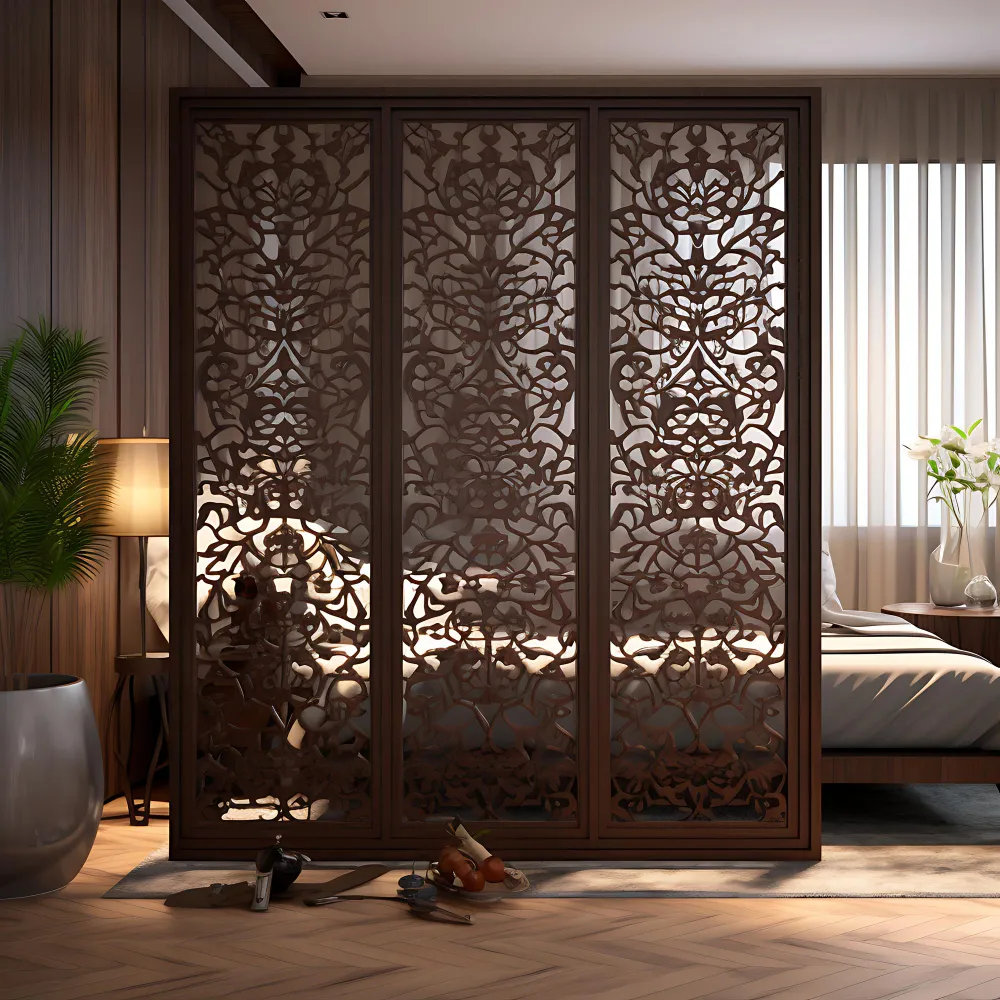
Understanding how a CNC workshop calculates your final bill can be highly confusing. Because every single custom design requires a unique toolpath, prices are never fixed. Rates depend heavily on material hardness, panel thickness, design complexity, and total machine running time.
You have just finalised a beautiful, intricate floral jali design for your new living room partition. You send the picture to three different fabricators across the city, and you receive three completely different quotations. One contractor gives you a massive number that blows your budget, while another gives you a rate so low that you immediately start doubting the finish quality. You are left completely confused, wondering how anyone actually calculates the CNC cutting price in Indore.
Pricing custom fabrication is not like buying a readymade product off a supermarket shelf. When you pay for CNC routing or laser cutting, you are essentially renting a highly advanced, computer controlled industrial robot by the minute. At Eish CNC Designs, clients frequently walk into our facility asking for a standard square foot rate. We always have to explain that a square foot of a simple square window takes twenty seconds to cut, while a square foot of a dense geometric arabesque pattern takes twenty minutes. The machine time is entirely different, which means the cost is entirely different.
We are writing this comprehensive guide to pull back the curtain on how modern fabrication workshops calculate costs. We will break down the exact technical variables that dictate your final bill. By understanding how the machine operates, you can actually design your projects smarter, saving money without compromising on the aesthetic appeal of your home interiors. Please note that because raw material costs and market variables fluctuate daily, we cannot list exact fixed prices here. To know the exact current rates for your specific project, you can always contact Eish CNC Designs directly for a free quotation.
Why is there no fixed CNC Cutting Price in Indore?
A fixed square foot price assumes that every design requires the same amount of effort. In the world of custom CNC manufacturing, this is mathematically impossible. A highly complex design forces the machine to travel a much longer distance, drastically increasing the cutting time and the final cost.
The interior design industry relies heavily on customisation. No two homes are identical, and no two clients want exactly the same wardrobe shutters. Because every project is unique, every project requires a unique toolpath generation process. The computer software has to translate your drawing into thousands of individual lines of G Code. This code tells the machine exactly where to move, how fast to travel, and how deep to plunge the cutting bit.
Imagine you want to cut a large plain circle out of a wooden board. The machine simply drops the bit into the wood, travels in one continuous sweeping motion, and finishes the job in two minutes. Now, imagine you want to cut a highly intricate tree of life pattern out of that exact same board. The machine has to plunge down, cut a tiny leaf, pull back up, travel to the next leaf, plunge down again, and repeat this process thousands of times. The machine is working incredibly hard, the expensive cutting bit is wearing down rapidly, and the job takes two full hours.
If a workshop offered a fixed flat rate for both of these panels, they would lose massive amounts of money on the complex tree design. This is exactly why professional fabricators calculate costs based on total machine running time rather than just the raw physical dimensions of the board. The more complex your design is, the longer it takes, and the higher the final bill will be.
Factor 1: Material Density and Hardness
The physical hardness of your chosen material directly dictates how fast the machine can safely travel. Soft materials can be cut at maximum speed. Extremely hard materials require very slow feed rates to prevent the cutting tool from snapping, which significantly increases the machine running time.
Not all materials are created equal. The density of the board you choose is one of the biggest variables affecting your final cost. Let us look at how different materials behave on the machine bed.
Standard Medium Density Fibreboard is relatively soft and incredibly uniform. Because there are no natural wood grains or hard knots hidden inside the board, the CNC router bit can travel at a very high speed without any fear of snapping. This high speed processing keeps the overall MDF jali cutting rates highly affordable. It is the perfect budget friendly material for decorative indoor applications.
Natural solid wood is an entirely different story. Hardwoods like Indian Teak or imported Oak are incredibly dense. If the machine operator tries to force the cutting bit through Teak at the same speed they use for MDF, the friction will instantly burn the wood, and the expensive solid carbide bit will snap in half. To cut solid hardwood safely and achieve a clean, splinter free edge, the machine must travel much slower. This slower feed rate means the job takes longer, which naturally increases the custom wood carving cost. When you bring premium timber to our workshop, we respect the material and process it with careful, calculated precision.
Factor 2: Material Thickness and Multipass Cutting
A machine cannot always cut completely through a thick material in a single motion. Thicker boards require the cutting bit to take multiple shallow passes to reach the bottom. More passes equal more time on the machine, driving up the final fabrication cost.
The thickness of your board plays a massive role in the pricing equation. Many clients assume that cutting an 18mm board takes the same amount of time as cutting a 6mm board. From an engineering perspective, this is incorrect.
Cutting tools experience immense lateral pressure when they push through solid material. If the router bit plunges 18mm deep into a hard board and tries to move sideways, the pressure will either snap the metal bit or stall the spindle motor completely. To prevent this, the programmer uses a technique called multipass cutting. For an 18mm board, the machine might cut 6mm deep on the first pass, travel the entire design path, drop down another 6mm for a second pass, and finally drop down the last 6mm to cut all the way through.
Because the machine has to travel over the exact same design path three separate times, the job takes three times longer than a single pass cut. If you are comparing quotes for custom wooden panels cost, you must make sure that you are comparing identical thicknesses. A thicker, chunkier partition will always cost more to fabricate simply because it demands significantly more machine time.
Factor 3: Design Complexity and Vector Density
The true cost driver in CNC manufacturing is vector density. A design with thousands of tiny, tight corners forces the heavy machine gantry to constantly accelerate and decelerate. This drastic reduction in average travel speed significantly inflates the machining time.
When we talk about design complexity, we are talking about vector geometry. Your digital drawing is made up of vector lines and curves. The total length of all these lines combined is called the cut length.
A minimalist, modern geometric pattern with long, straight lines has a very short total cut length. The machine can accelerate to its top speed and cruise down those long straight paths effortlessly. The job finishes quickly, and the cost remains low.
Conversely, a traditional, highly ornate floral jali pattern consists of thousands of tiny, interconnected curves and sharp inside corners. An industrial CNC machine is a massive, heavy piece of equipment. Just like a sports car navigating a tight winding mountain road, the heavy machine gantry cannot maintain top speed through sharp corners. It has to constantly slow down to negotiate the tight curves accurately, and then accelerate again. This constant braking and accelerating means the average cutting speed drops dramatically.
If you have a tight budget, the easiest way to lower your final bill is to simplify your design. Choosing a pattern with larger cutouts and fewer intricate details will dramatically reduce the machine time.
Factor 4: 2D Cutting vs 3D Relief Carving
The fundamental difference in machining techniques dictates a massive price gap. 2D cutting simply traces an outline and cuts completely through the board. 3D carving sculpts the surface using a tiny tool that steps over by fractions of a millimetre, a process that takes hours to complete.
This is where clients experience the biggest sticker shock. People often confuse 2D cutting with 3D carving, assuming they cost roughly the same. The technical difference between the two processes is vast.
In 2D CNC cutting, the tool plunges through the material and simply traces the outline of your design, dropping the cut out pieces into the waste bin. It is a highly efficient process. The 2D CNC design cost is generally very affordable because the machine only has to travel along the perimeter of the shapes.
3D relief carving is a completely different world. We are not cutting through the board. We are sculpting a three dimensional image, like a face of a deity or a textured rippling wave, directly into the solid surface of the board. To achieve smooth, sloping curves without visible tool marks, we have to use a tiny ball nose router bit, often just 3mm or 4mm in diameter.
The machine moves across the board, carving a single microscopic line, and then steps over by just 0.1 or 0.2 millimetres to carve the next line. It goes back and forth, line by line, over the entire surface area of the panel. A large 3D carving on a solid wood door or HDHMR board can take ten to fifteen hours of continuous machine running time. Because of this massive time investment, HDHMR 3D carving rates are substantially higher than simple 2D cutout rates. The final result is a breathtaking, sculptural piece of art, but it requires a very different budget.
Factor 5: CAD Design and Machine Programming
Before the machine can even power on, an experienced programmer must translate your idea into a language the machine understands. Preparing a clean, error free vector file and generating safe toolpaths is a highly skilled technical task that factors into your final quotation.
A CNC machine is incredibly dumb. It only does exactly what it is told to do by the computer code. It cannot look at a blurry JPEG image downloaded from the internet and understand how to cut it.
If a client brings us a perfect, ready to cut AutoCAD (.dxf) file, we can generate the toolpaths in a few minutes, saving time and money. However, clients often bring us rough pencil sketches or low resolution screenshots from Pinterest. Our design team has to manually trace that image, perfectly close every single vector loop, correct the scaling, and adjust the spacing so the physical material does not snap during cutting.
Once the drawing is perfect, the programmer has to assign specific cutting tools, calculate the correct spindle speeds, feed rates, and plunge depths based on the chosen material. This CAD/CAM preparation takes significant expertise. The time our engineers spend sitting at the computer ensuring your file is absolutely perfect is a critical component of the overall pricing structure.
Factor 6: Bulk Production vs Single Custom Piece
The economy of scale applies heavily to CNC manufacturing. Setting up the machine, aligning the material, and generating the toolpath takes the same amount of time whether you are cutting one single panel or one hundred identical panels.
Setup time is a massive hidden cost in manufacturing. Let us assume a client wants a single, custom engraved wooden nameplate. The operator has to clean the machine bed, clamp the small piece of wood down securely, load the specific engraving bit, zero the machine coordinates to the exact corner of the block, and run the program. The actual engraving might only take five minutes, but the setup took fifteen minutes.
Now, imagine an interior contractor orders fifty identical wardrobe shutters for a large apartment project. The programmer generates the toolpath once. The operator loads a massive full size MDF sheet onto the bed, turns on the vacuum hold down system, and the machine cuts ten shutters out of that one sheet automatically. The setup time is spread out over fifty units, making the cost per unit drastically cheaper.
If you want to access highly affordable CNC cutting services, combining your requirements into a single bulk order will always yield a much better rate than ordering individual small pieces piecemeal over several months.
Acrylic Laser Cutting Price Factors
Laser cutting uses a concentrated beam of intense light instead of a physical spinning metal bit. The cost depends on the thickness of the acrylic sheet, the complexity of the signage or pattern, and the specific edge finish required.
When clients need crisp, polished edges for backlit signage or modern display boxes, they turn to our acrylic laser cutting services.
The acrylic laser cutting price is calculated differently than wood routing. Because a laser beam has no physical mass, there is zero lateral pressure on the material. We do not need heavy clamps to hold the sheet down. However, the laser beam loses cutting power as it penetrates deeper into thick material.
Cutting a thin 2mm acrylic sheet is incredibly fast. The laser zips through the plastic effortlessly. If you want to cut a massive 12mm or 20mm thick block of clear cast acrylic for a luxury trophy or a heavy duty machine guard, the laser head must move at an agonisingly slow crawl to melt all the way through that dense plastic. Furthermore, creating a perfectly clear, flame polished edge on thick acrylic requires immense calibration and precise focal length adjustments, all of which contribute to the final cost.
CNC Metal Cutting Services Pricing
Metal fabrication requires incredibly expensive industrial fibre laser machines. The pricing depends on the type of metal (Mild Steel vs Stainless Steel), the thickness of the plate, and the expensive industrial assist gases required to blow molten metal out of the cut zone.
Cutting solid steel is an entirely different ballgame. Our CNC metal cutting services pricing reflects the extreme industrial nature of the equipment required. A fibre laser machine is a massive capital investment, and its running costs are very high.
The biggest variable in metal cutting is the assist gas. When the laser beam melts the solid steel, a high pressure jet of gas blasts the molten metal out of the cut channel before it can harden again. If we are cutting standard Mild Steel (MS) for outdoor gates or industrial brackets, we generally use Oxygen as the assist gas. The Oxygen actually creates an exothermic reaction, burning the steel and helping the laser cut much faster, which keeps the CNC laser cutting charges in Indore relatively low for MS.
However, if we are cutting premium Stainless Steel (SS) for luxury interior inlays or sterile food grade equipment, we cannot use Oxygen because it will heavily oxidise and blacken the edge. We must use high pressure industrial Nitrogen gas. Nitrogen provides a perfectly clean, bright, oxide free edge, but it consumes massive amounts of expensive gas cylinders. Therefore, cutting Stainless Steel will always carry a higher premium than cutting standard Mild Steel.
Why Cheap CNC Cutting Services End Up Costing More
Choosing the lowest possible quote is often a huge mistake in custom fabrication. Cheap workshops cut corners by using dull, worn out bits, running machines dangerously fast, and ignoring calibration, resulting in ruined materials and rejected installations.
In a competitive market, you will always find someone willing to do the job cheaper. But in CNC manufacturing, you absolutely get what you pay for. How does a workshop offer rates that are drastically lower than the industry standard?
They do it by pushing the machine beyond its safe limits. To save time, an operator might increase the feed rate to maximum speed. This aggressive cutting causes the router bit to violently tear the wood fibres instead of slicing them cleanly. The result is a furry, splintered edge that will require your carpenters to spend days manually sanding and filling with putty. The money you saved on the cutting rate is instantly lost paying daily wages to your carpenters to fix the mess.
Worse, cheap operators refuse to replace expensive carbide cutting bits when they get dull. A dull bit creates massive friction, burning the edges of your MDF or solid wood black. They might also skip the multipass cutting process on thick materials, risking a snapped bit that gouges deeply into the middle of your expensive premium Teak wood panel, completely destroying your raw material.
Professional CNC router cutting charges include the cost of proper machine maintenance, fresh sharp tooling, and the expertise to run the job at the correct, safe speeds. Paying for quality fabrication guarantees a perfect fit, crisp edges, and zero wasted material.
How to Get an Accurate Quote for Your Project
To receive a precise quotation without hidden surprises, provide your fabricator with a clear vector file, the exact material specification, the required thickness, and the total quantity. Vague descriptions lead to vague pricing estimates.
We want to give you the most accurate pricing possible. To do that, we need specific information. If you message us asking, "What is your rate for a jali design?", we cannot give you a real answer. It is like asking a car dealer, "How much for a vehicle?"
When you contact us, please try to provide the following details:
- The Design File: An AutoCAD (.dxf) or CorelDraw (.cdr) vector file is ideal. If you only have a reference photo, send a clear, high resolution image so our design team can estimate the tracing time.
- The Material: Specify exactly what you want us to cut. Are we cutting interior grade MDF, exterior grade HDHMR, premium CP Teak, clear Acrylic, or Mild Steel?
- The Thickness: Tell us the exact thickness of the board in millimetres.
- The Quantity: Let us know if this is a single custom prototype or a massive bulk order for an entire commercial building.
Once we have this information, our engineers load your file into our CAM software. The software simulates the entire toolpath and calculates the exact machine running time down to the minute. This allows us to provide a highly transparent, mathematically accurate quotation with zero guesswork.
Why Choose Eish CNC Designs in Indore
We combine state of the art industrial CNC machinery with years of technical programming expertise. We treat your raw materials with absolute respect, ensuring zero wastage, crisp edge finishing, and prompt delivery schedules for every project across Indore.
At Eish CNC Designs, we pride ourselves on being the most reliable fabrication partner for architects, interior designers, builders, and homeowners in Indore. Our facility is equipped with heavy duty, rigid industrial machines that do not vibrate or lose steps during complex operations. We invest heavily in premium solid carbide cutting tools to ensure every single cut is flawless.
We understand that in the interior design industry, timelines are critical. A delayed partition panel holds up the painters, the polishers, and the final handover of the site. We provide transparent lead times and stick to our delivery commitments. Whether you need a simple wooden partition design or a highly complex 3D carved luxury main door, our team is dedicated to exceeding your expectations.
Final Verdict: Partner with the Experts
Understanding the variables behind CNC pricing empowers you to make smarter design choices. You now know that material density, panel thickness, vector complexity, and machine time all play a crucial role in the final calculation. By balancing your aesthetic desires with these technical realities, you can achieve stunning custom interiors without blowing your budget.
Are you ready to bring your custom designs to reality? Stop guessing about fabrication costs and let our experts calculate the exact requirements for your specific project. Whether you need an estimate for intricate MDF jali cutting, deep 3D timber carving, or heavy duty metal laser cutting, we are here to help. Contact Eish CNC Designs today, or send your drawings directly via WhatsApp for a fast, free, and completely transparent quotation!
Frequently Asked Questions
Why do different CNC workshops quote different prices for the same design?
Different workshops use different grades of machinery. A high end industrial machine cuts faster and cleaner but has higher running costs. A workshop offering extremely cheap rates might run the machine too fast, resulting in burnt edges or inaccurate dimensions that ruin your material.
Is 3D CNC carving more expensive than standard 2D cutting?
Yes, 3D carving is significantly more expensive. A standard 2D cut goes straight through the material in a few minutes. 3D carving requires a tiny routing bit to pass over the material thousands of times to create depth, which can take hours of machine time.
Do I have to pay extra if I bring my own material?
You can definitely supply your own material. In that case, you will only be charged for the machine time and programming. However, if the material is heavily warped or contains hidden metal nails, we may refuse to cut it to protect our machine bits.
How can I get the exact CNC cutting price for my project?
The fastest way to get an exact rate is to send your vector design file to Eish CNC Designs via WhatsApp or email, along with your material choice and thickness. We will simulate the toolpath on our software and provide an accurate quotation.