
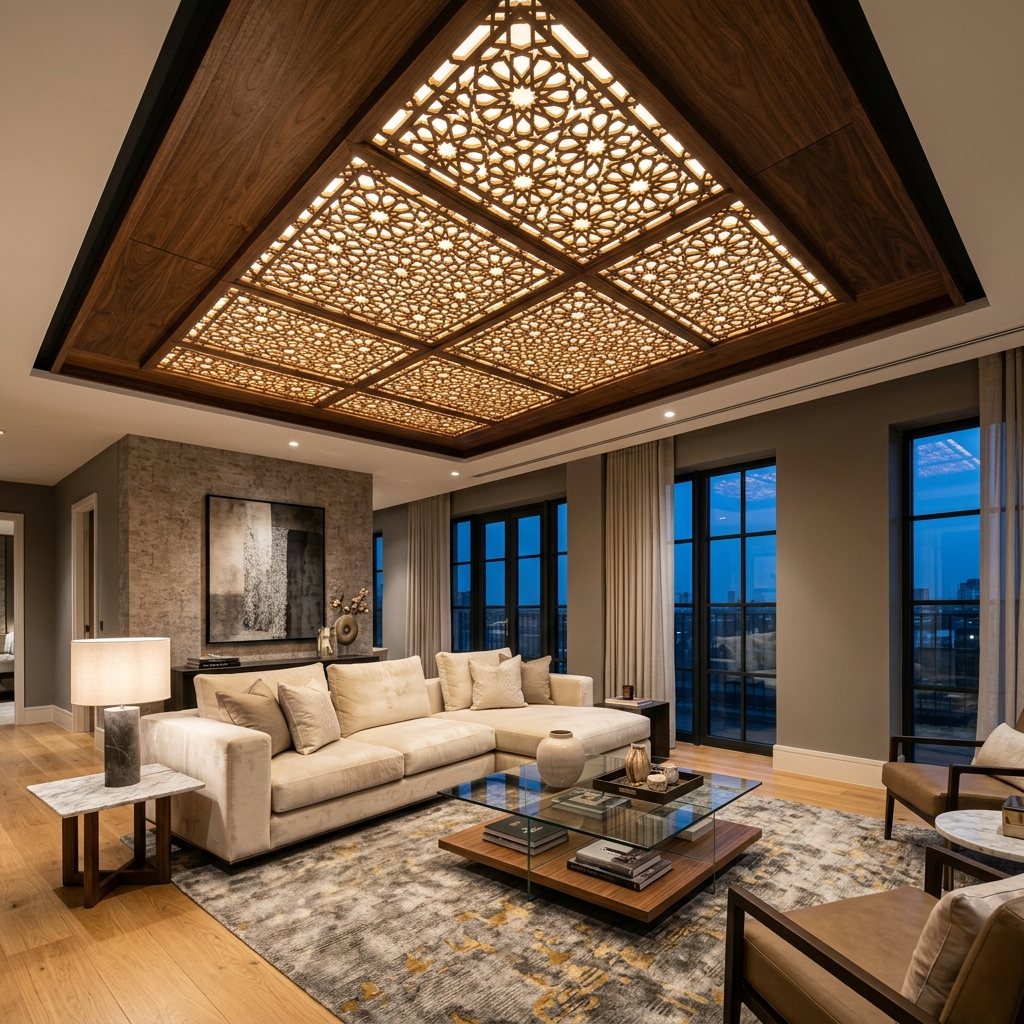
You are staring up at a bare, flat concrete roof, trying to figure out how to add character to your new living room. Standard Plaster of Paris (POP) feels boring, predictable, and frankly, a little outdated. You want a space that feels luxurious, warm, and inviting. The solution that top interior designers and architects are turning to is a custom MDF jali design for ceiling.
Gone are the days when a ceiling was just a place to hang a fan. Today, the "fifth wall" of your room is a blank canvas for architectural expression. By integrating precision computer controlled routing with ambient lighting, a plain overhead surface can be transformed into a breathtaking focal point. Whether you are building a modern minimalist apartment or a traditional Indian bungalow, custom routed panels offer unparalleled design flexibility.
At Eish CNC Designs, we process hundreds of overhead panel requests every month. However, ceiling installations require a very different approach compared to standard wall partitions. Gravity, lighting integration, weight limits, and structural framing all play a critical role in the success of your project. This comprehensive guide will answer all the deep technical questions you have about overhead CNC installations, ensuring your next interior project in Indore is safe, stunning, and built to last.
Why Choose an MDF Jali Design for Ceiling Over Traditional POP?
MDF offers precision computer routing that manual POP work simply cannot match. It allows for intricate geometric or floral patterns that transform a basic roof into a luxury statement piece, offering absolute consistency across large surface areas.
For decades, Indian homes relied exclusively on Plaster of Paris for false ceilings. While POP is great for creating basic boxes and coves, it severely limits your decorative options. Manual POP carving is messy, incredibly time consuming, and highly dependent on the skill of the individual labourer. If the artisan makes a mistake, the entire pattern looks asymmetrical and sloppy.
A modern pop and mdf ceiling design completely changes the game. By combining a clean POP border with a central CNC routed MDF insert, you get the best of both worlds. An industrial CNC machine operates on digital coordinates. If you want a complex Moroccan star pattern repeated perfectly across a twelve foot span, the machine will cut it with microscopic accuracy. Every single edge is crisp, sharp, and identical.
Furthermore, MDF offers warmth. A wooden finish mdf ceiling brings a natural, organic texture into the room that cold white plaster simply cannot replicate. You can polish it to look like expensive Teak or Walnut, or you can paint it in a high gloss PU finish to match your modern modular furniture. The aesthetic possibilities are literally endless.
What is the Ideal Thickness for a Ceiling MDF Panel?
Never use extremely thick boards for overhead installations. A 6mm or 8mm MDF board is the perfect balance between structural integrity and lightweight safety, ensuring your ceiling does not collapse under its own weight.
When clients visit our workshop, they often request 18mm or even 25mm boards for their ceilings, assuming that thicker means better. For a wall partition or a heavy duty door, thick boards are excellent. For a ceiling, thick boards are incredibly dangerous.
Gravity is the enemy of any false ceiling. An 18mm dense fibreboard sheet is tremendously heavy. Hanging that much dead weight directly above your family requires heavy duty industrial rigging. If the wooden framing weakens over the years, a heavy panel can rip out the screws and cause a catastrophic collapse.
For a beautiful bedroom ceiling mdf panel, you only need the visual effect of the cutout. A 6mm or 8mm thick board is absolutely ideal. It is light enough for standard aluminium or pine wood framing to support effortlessly. Because a CNC machine cuts so cleanly, an 8mm board still provides gorgeous depth and shadow play when backlit. We strictly advise all our interior design partners to keep ceiling panels as lightweight as mathematically possible.
How to Create a Stunning Backlit MDF Ceiling Design
The magic of a CNC ceiling lies in the lighting. By placing warm LED strip lights behind an acrylic sheet with mdf jali, you create a soft, diffused ambient glow that eliminates harsh shadows in your living space.
A beautifully carved panel looks good in daylight, but it looks absolutely spectacular at night. A backlit mdf ceiling design serves as a massive, custom built chandelier that floods your room with soft, indirect ambient light. However, getting the lighting right requires a specific installation technique.
The biggest mistake contractors make is placing raw LED strip lights directly behind the wooden cutouts. When you look up, you will see the harsh, ugly dots of the individual LED bulbs blinding your eyes. This ruins the luxury aesthetic completely.
The correct method is the sandwich technique. First, you mount your LED strips evenly on the true concrete ceiling. Below that, you install a translucent milky white acrylic sheet. Finally, you mount the custom routed MDF panel directly below the acrylic. This creates a beautiful acrylic sheet with mdf jali sandwich. The milky acrylic diffuses the harsh LED dots, turning them into a smooth, even, cloud like glow that pushes gently through the wooden cutouts. This is the secret to achieving that premium hotel lobby look in your own home.
Top CNC Cutting Design for Roof Patterns in 2026
From Moroccan geometric stars to traditional Indian floral mandalas, the pattern you choose dictates the entire mood of the room. Geometric lines suit modern minimalist homes, while dense floral designs perfectly complement classic heritage interiors.
Selecting the right vector pattern is arguably the most exciting part of the process. The design you choose for your overhead panel will cast distinct shadows across your floor and walls, setting the fundamental tone for your interior decor.
If you are designing a contemporary, ultra modern apartment, you should look at abstract geometric patterns. Clean straight lines, intersecting hexagons, and asymmetrical digital grids are incredibly popular right now. These minimalist cnc cutting design for roof patterns pair beautifully with track lighting and modern glass furniture.
On the other hand, if you are looking for living room jali ceiling ideas for a traditional Indian home or a pooja room, classic floral mandalas and intricate Mughal inspired arabesque patterns are the way to go. These dense, sweeping curves look absolutely breathtaking when finished in a rich mahogany or teak wood polish. Because our heavy duty routing machines cut with zero vibration, even the tightest, most delicate floral curves are rendered flawlessly without any rough edges.
HDHMR vs MDF for False Ceiling: Which is Better?
Standard MDF is perfect for dry areas like living rooms and bedrooms. However, for bathrooms, covered balconies, or homes in highly humid climates, High Density High Moisture Resistance (HDHMR) boards are strictly recommended to prevent swelling.
One of the most frequent questions we receive from architects is the debate between hdhmr vs mdf for false ceiling applications. The answer depends entirely on the specific room you are renovating.
Standard Medium Density Fibreboard is an excellent, cost effective material. If you are installing a panel in an air conditioned master bedroom or a dry central living room, standard MDF will last for decades without a single issue. It routes beautifully and takes paint exceptionally well.
However, MDF acts like a sponge when exposed to direct moisture. If you are designing a false ceiling for a luxury bathroom, a damp basement, or an outdoor covered patio, standard MDF will absorb the moisture in the air, swell up, and eventually crumble. For these wet zones, you must upgrade to HDHMR. HDHMR boards are manufactured using special water resistant resins that make them virtually immune to atmospheric moisture. While HDHMR is slightly more expensive, it is a mandatory investment for any ceiling exposed to high humidity.
Does an MDF Ceiling Sag Over Time?
A properly installed CNC ceiling will never sag. The secret lies in creating a rigid aluminium or wooden framing grid spaced at strict intervals to support the lightweight panel perfectly across its entire surface area.
A very common fear among homeowners is that a wooden panel will warp, bow, or sag in the middle over the years, creating a dangerous and ugly dip in their living room roof. This is a valid concern, but it is completely preventable.
Sagging has nothing to do with the quality of the CNC cutting; it is entirely a failure of the installation framework. If a contractor tries to save money by placing support beams four feet apart, the thin MDF panel will inevitably droop in the unsupported center. Wood is an organic material that flexes under its own weight.
To prevent sagging entirely, your carpenters must build a tight, rigid grid using premium aluminium channels or seasoned pine wood battens. The support beams should be spaced no more than eighteen to twenty four inches apart. The MDF panel must be securely screwed into this tight grid at multiple points. When supported by a strict, closely spaced framework, a lightweight 8mm panel will remain perfectly flat and rigid for the lifetime of your home.
How to Protect Your Wooden Finish MDF Ceiling from Termites
Termites love untreated wood fibre. To protect your investment, you must always apply a high quality anti termite chemical primer to all sides of the board before painting, or opt for pre treated termite proof boards.
In India, termites are a severe threat to any wooden interior element. A beautiful ceiling can be completely hollowed out by a termite infestation in a matter of months if proper precautions are not taken. Because a false ceiling is high up and difficult to inspect regularly, prevention is your only line of defense.
Before the routed panel is hoisted up to the ceiling, it must be chemically treated on the ground. Your polishing team must apply a heavy coat of premium anti termite wood preservative to both the front face, the back face, and critically, inside every single routed cutout edge. The edges are where the raw wood fibres are exposed, making them the most vulnerable entry point for pests.
Once the chemical preservative has soaked deeply into the fibres and dried completely, the panel can be primed and painted. If you live in an area known for severe ground termite issues, we strongly suggest discussing termite proof HDHMR boards with our team at Eish CNC Designs before we begin the cutting process.
Understanding False Ceiling Jali Design Price Factors
Pricing depends heavily on the complexity of your vector pattern and the total machine cutting time. A simple grid is highly affordable, while a dense, intricate mandala requires hours of machine travel, increasing the fabrication cost.
Budgeting for a custom ceiling requires understanding how fabrication costs are calculated. Many clients ask us for a flat false ceiling jali design price per square foot, but custom routing simply does not work that way.
When you rent time on a highly advanced industrial CNC router, you are paying for the machine running time. If you choose a minimalist modern design with a few large, straight rectangular cutouts, the machine can zip through the board in fifteen minutes. The cost for this panel will be extremely low and highly affordable.
Conversely, if you choose an incredibly dense Rajasthani floral jali pattern with thousands of tiny interlocking petals and sharp curves, the heavy machine gantry must slow down drastically to negotiate every single corner. A single board might take three hours to cut. The immense machine time, combined with the wear and tear on the expensive solid carbide cutting bits, naturally drives the price up. To get an exact, mathematically precise quotation for your specific pattern, we always recommend sharing your AutoCAD file directly with our engineering team.
How to Clean a CNC Carved Ceiling Safely
Never use wet mops or liquid sprays on an overhead MDF installation. Always use a dry, clean microfiber duster on an extension pole or a vacuum cleaner with a soft brush attachment to gently remove trapped dust.
Once your stunning backlit ceiling is installed and glowing beautifully, you need to know how to maintain it. Over the months, the intricate cutouts of your jali design will inevitably collect airborne dust, which can dull the glow of your LED lights.
The golden rule for maintaining any woodwork is moisture control. You must never spray liquid glass cleaners, water, or wet chemical polishes directly onto an overhead MDF panel. Liquid will seep into the routed edges, bypassing the paint, causing the wood fibres to swell and peel.
Cleaning should be a completely dry process. Invest in a high quality microfiber feather duster attached to a telescopic extension pole. Once a month, gently run the dry duster across the cutouts to capture the loose dust. For a deeper clean, you can use a standard household vacuum cleaner fitted with a soft bristle brush attachment. Keep the suction on a low setting and gently vacuum the routed grooves. This dry, gentle maintenance routine will keep your ceiling looking absolutely brand new for decades.
Why Eish CNC Designs is Your Best Partner in Indore
We provide flawless, computer precision routing for all overhead installations. Our industrial heavy duty machines ensure zero splinters, perfect edges, and rapid delivery for your custom residential and commercial projects.
Creating a large scale ceiling installation requires a fabricator you can trust. At Eish CNC Designs, we specialise in manufacturing flawless custom cnc ceiling panels in Indore. We understand that overhead panels require absolute precision. If a panel is cut even two millimetres out of square, it will not align properly on the ceiling grid, ruining the entire visual aesthetic of the room.
Our facility uses massive, rigid industrial machines that guarantee zero vibration during the cutting process. We use brand new, razor sharp tooling for every major project, ensuring that your delicate ceiling jali has crisp, smooth edges that require zero manual sanding by your carpenters. We eliminate the messy, inaccurate guesswork of manual labour, delivering mathematically perfect panels directly to your project site.
Final Verdict: Transform Your Fifth Wall Today
An MDF jali design for your ceiling is not just a decorative afterthought; it is a powerful architectural tool that defines the luxury and warmth of your entire living space. By choosing the right lightweight thickness, applying proper termite protection, and utilizing the acrylic sandwich lighting technique, you can achieve a magazine cover look right in your own home.
Are you ready to elevate your interior design? Do not settle for boring, flat plaster roofs. Whether you are an architect planning a massive commercial lobby or a homeowner designing your dream bedroom, we have the machinery and the expertise to bring your exact vision to life in solid wood, MDF, or acrylic. Get in touch with our engineering team at Eish CNC Designs today. Send us your vector files or reference images, and let us build something extraordinary above your head.