
Your carpenter suggests plywood for the kitchen. Your interior designer insists on HDHMR. Meanwhile, you are staring at a quotation for MDF that is half the price and wondering if you are about to make a very expensive mistake.
The engineered wood market in India has exploded in recent years, leaving homeowners and contractors drowning in acronyms. Choose the wrong board for the wrong application, and you will find your wardrobe doors sagging after six months or your bathroom vanity swelling like a sponge. The debate of MDF vs HDHMR is one we have every single week at Eish CNC Designs.
We process thousands of square feet of these materials through our CNC wood routing and carving machines. We see exactly how they behave when cut, carved, painted, and installed. This is not a theoretical comparison. This is a practical, shop-floor breakdown of what these materials actually are, where they fail, and where they excel.
What exactly is MDF (Medium Density Fibreboard)?
MDF (Medium Density Fibreboard) is an engineered wood product made by breaking down wood residuals into fine fibres, mixing them with wax and resin, and pressing them into dense, flat panels. It offers a perfectly smooth, knot-free surface ideal for painting and dry-area interior applications.
When you look at the edge of an MDF board, you won't see layers like you do in plywood. You see a uniform, dense block of material. The MDF density typically ranges between 600 to 800 kg/m3. Because it is made of fine fibres rather than wood chips (like particle board) or veneers (like plywood), the surface is incredibly smooth and completely free of natural wood grain or knots.
This smoothness is its greatest asset. When you apply Duco paint, PU polish, or a high-gloss acrylic finish to MDF, the result is flawless. There is no texture bleeding through to ruin the reflection. For decorative applications in dry areas, like TV unit backing, bedroom wall panelling, or intricate jali room dividers, MDF is often the most logical choice.
However, that same fibre construction is its weakness. The standard urea-formaldehyde resin used in regular MDF is not waterproof. If water penetrates the surface or the unsealed edges, the wood fibres drink it up instantly. The board swells, loses its structural integrity, and crumbles. Once MDF swells, it never shrinks back to its original shape.
What exactly is HDHMR?
HDHMR stands for High Density High Moisture Resistance. It is a premium engineered board made from dense forest wood waste bonded with water-resistant synthetic resins under extreme pressure. This creates a highly durable, water-resistant panel with a density exceeding 850 kg/m3, perfect for humid environments.
HDHMR is manufactured using wood fibres sourced from dense forest wood waste, typically eucalyptus or similar hardwood species. Instead of standard resins, these fibres are bonded using special water-resistant synthetic resins (often melamine-based) and pressed under extreme temperature and pressure. The resulting board has a density well above 850 kg/m3, often pushing past 900 kg/m3.
This increase in density changes the physical properties of the board entirely. The HDHMR moisture resistance is its primary selling point. While it is not completely waterproof, it is highly water-resistant. You can install it in a humid Mumbai apartment or a steamy Indore bathroom, and it will maintain its structural integrity for decades without swelling.
Most manufacturers dye the core of HDHMR green to differentiate it from standard brown MDF. If you are buying HDHMR, look for that green core. You should always verify the manufacturer's stamp too, as some local brands add green dye to standard MDF to fake the premium product.
MDF vs HDHMR for kitchen installations
When choosing between MDF and HDHMR for a modular kitchen, HDHMR is the definitive winner. Its specialised water-resistant resins prevent swelling in humid environments, and its extreme density provides the superior screw-holding capacity required for heavy cabinet doors that are opened daily.
Kitchens are hostile environments for engineered wood. They deal with steam from cooking, accidental spills, wet utensils being put away, and regular mopping of the floor. Using standard MDF for kitchen cabinets or under-sink units is a recipe for disaster. The continuous exposure to moisture will inevitably cause the MDF to bloat, especially around the hinges and edge banding where moisture usually finds an entry point.
MDF vs HDHMR for kitchen cabinets comes down to two factors: moisture resistance and screw holding capacity.
Because HDHMR is so dense, it grips screws tightly. A kitchen cabinet door is opened and closed thousands of times a year. The heavy-duty hinges carry a lot of weight. In standard MDF, the repetitive stress eventually grinds the wood fibres to dust, causing the screws to pull out. In HDHMR, the screws stay firmly anchored. Many interior designers now prefer HDHMR over commercial plywood for kitchen shutters because it offers the screw-holding capacity of plywood with the perfectly smooth painting surface of MDF.
If you are on a very tight budget, the only place MDF belongs in a kitchen is as a decorative spacer or a ceiling filler panel, somewhere far away from the sink, the stove, and the floor. For budget-friendly decorative MDF work, our CNC MDF cutting services in Indore are a great starting point.
HDHMR vs MDF strength and durability
In terms of strength and durability, HDHMR significantly outperforms standard MDF. The higher density of HDHMR makes it remarkably stiff, resisting sagging on wide shelves and preventing edge chipping from impacts. It behaves more like solid hardwood, ensuring furniture lasts longer under heavy use.
HDHMR is remarkably stiff. If you use an 18mm HDHMR board for a wide wardrobe shelf, it will resist sagging far better than 18mm MDF. The high density means the internal bond between the wood fibres is incredibly strong. When we run MDF vs HDHMR durability tests on the shop floor, the difference is obvious just by trying to snap an offcut.
HDHMR also has superior edge density. If you bump a piece of furniture made of standard MDF with a vacuum cleaner or a heavy boot, the edge can easily dent or chip. HDHMR behaves more like solid hardwood, taking impact well without crumbling. This makes it a vastly superior choice for skirting boards, door frames, and high-traffic commercial interior design materials.
A question that comes up often is whether HDHMR is heavier than plywood. Yes, significantly heavier. Because HDHMR has a density exceeding 850 kg/m3, an 8x4 sheet of 18mm HDHMR is extremely heavy. This weight gives the furniture a solid, premium feel, but it also means your carpenter must use high-quality, heavy-duty hardware (like 3D adjustable hinges) to support the weight of the doors. Cheap hinges will fail under the weight of an HDHMR shutter.
Pricing and value: MDF vs HDHMR cost
The cost of HDHMR boards is typically 40% to 60% higher than standard interior-grade MDF of the same thickness. While MDF is budget-friendly for temporary retail displays, the premium price of HDHMR is a necessary investment for residential furniture that needs to resist moisture and last for decades.
When comparing MDF vs HDHMR cost, you can expect the HDHMR board price to be roughly 40% to 60% higher than standard interior-grade MDF of the same thickness.
For example, if a standard 18mm 8x4 MDF sheet costs Rs. 1,800, the equivalent HDHMR sheet will likely cost between Rs. 2,600 and Rs. 3,000. For a massive commercial fit-out, that price difference adds up quickly. This is why commercial retail stores often use MDF for their display units. They change their layouts every few years, so extreme longevity isn't required, and the cost savings are substantial.
However, for a residential home where you expect the furniture to last 15 to 20 years, the price difference is negligible compared to the total cost of the project (which includes hardware, laminates, paint, and labor). Saving Rs. 1,000 on a sheet of board only to have to rebuild a ruined bathroom vanity three years later is false economy.
CNC Carving on HDHMR vs MDF
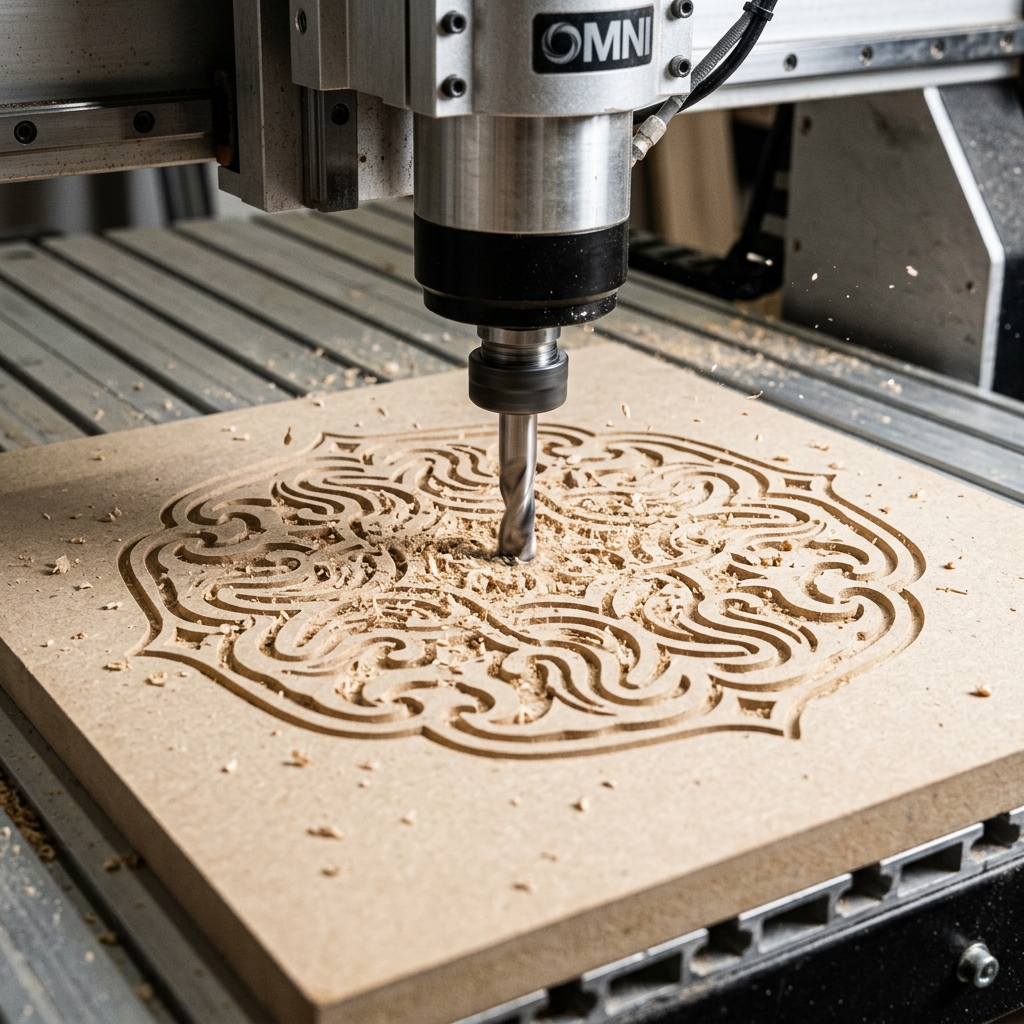
Both materials perform well on CNC routers, but HDHMR yields superior results for complex 3D carving. Its uniform high density allows for crisp, sharp cuts without edge fuzzing, requiring significantly less sanding than MDF. For basic 2D jali cutting, standard MDF remains a cost-effective and adequate choice.
CNC carving on HDHMR is an absolute pleasure. Because the density is so high and uniform, the router bits cut through it cleanly. When we run complex 3D relief carvings, like a detailed Ganesh panel or a deep floral motif, HDHMR holds the finest details without any edge fuzzing or chipping. The carved surface requires significantly less sanding and prep work before painting compared to standard MDF or plywood.
Standard MDF also routes very well. In fact, for 2D cutouts and standard jali partitions, MDF is completely fine. It cuts slightly faster than HDHMR, saving a little on machine time. However, on deep 3D carvings, the core of standard MDF is often slightly softer and less dense than the outer faces. When the router bit digs deep into that softer core, it can leave a slightly "furry" texture that requires manual sanding and heavy primer coats to seal properly.
For high-end clients who want deep texture wall panels or intricate 3D carving, we almost exclusively recommend HDHMR. The time saved in the finishing and polishing stage more than makes up for the higher raw material cost. If you are commissioning decorative 2D CNC cutting work like jali patterns and room dividers, standard MDF is perfectly adequate.
HDHMR for Wardrobe Doors
HDHMR is the ideal engineered material for wardrobe doors, especially for tall, floor-to-ceiling shutters. Unlike plywood which can warp, HDHMR remains perfectly flat over long lengths and provides a flawlessly smooth substrate for high-gloss PU paint, premium laminates, or acrylic finishes.
Because the core is incredibly dense, your hinges and handles stay firmly attached without loosening over the years. This eliminates the frustrating problem of sagging doors in modern bedroom interiors.
HDHMR Edge Banding Requirements
Yes, HDHMR absolutely requires edge banding. Although the board is highly water-resistant, leaving raw edges exposed provides an entry point for moisture. Proper edge banding seals the board completely, ensuring longevity and providing a clean, finished look to your interior cabinetry.
We strongly recommend using high-quality PVC or acrylic edge bands applied with heat-resistant PUR glue. This protects the vulnerable core from ambient humidity and creates a seamless, professional edge.
Termite Resistance of HDHMR
HDHMR is highly resistant to borers and termites because manufacturers treat the dense wood fibres with specific anti-termite chemicals and synthetic resins during the pressing process. Standard MDF offers almost no pest resistance, making HDHMR the safer investment for long-lasting interior furniture.
This integrated chemical protection means you won't need to worry about repeated, toxic pest control treatments. It provides absolute peace of mind for your expensive custom woodwork and cabinetry installations.
At a Glance: MDF vs HDHMR Comparison
| Feature | MDF (Medium Density Fibreboard) | HDHMR (High Density High Moisture Resistance) |
|---|---|---|
| Density | 600 - 800 kg/m3 | 850 - 950+ kg/m3 |
| Moisture Resistance | Very Low. Swells when wet. | Excellent. Highly water-resistant. |
| Screw Holding Capacity | Moderate. Can loosen over time. | Superior. Grips screws tightly. |
| CNC Carving Quality | Good. Minor sanding required on deep cuts. | Exceptional. Crisp, sharp edges even on deep 3D reliefs. |
| Best Applications | Dry areas, decorative panels, display units. | Kitchens, bathrooms, structural furniture, premium doors. |
| Cost | Budget-friendly. | Premium (40-60% higher than MDF). |
The Interior Design Materials Perspective
Leading architects and interior designers now specify HDHMR over commercial plywood for visible vertical surfaces like doors and panelling. HDHMR provides a glass-like finish directly from the factory, eliminating the extensive surface preparation and sanding required to hide the natural grain of traditional plywood.
The reason is simple: finishing. Modern interiors demand flawless, glossy, or ultra-matte finishes. Plywood requires extensive surface preparation, putty application, and sanding to hide its natural grain before it can be painted. Even then, over time, the grain can telegraph through the paint. HDHMR provides a glass-like substrate directly from the factory. Read our detailed comparison of MDF vs Plywood for CNC carving if you are deciding between those two materials instead.
Final Recommendation: Which should you buy?
Choose standard MDF for dry living areas, decorative jali partitions, or budget-conscious display units. Choose HDHMR for modular kitchens, bathrooms, heavy wardrobe doors, and intricate 3D CNC carving where moisture resistance, screw-holding capacity, and long-term durability justify the higher initial investment.
If you are panelling a dry living room wall, creating a decorative MDF jali design, or building retail display units where budget is a primary concern, use standard MDF. It will perform perfectly well in a dry environment and save you money.
If you are building a modular kitchen, a bathroom vanity, heavy-duty wardrobe doors, or commissioning intricate 3D CNC wood carving that you want to last for decades, spend the extra money and buy HDHMR. The peace of mind, moisture resistance, and superior finish are worth every extra rupee.
Need help deciding on the right material for your next CNC carving or laser cutting project in Indore? Contact Eish CNC Designs. Bring us your designs, and we will guide you toward the perfect material for your budget and application.
Frequently Asked Questions
Which is better for a modular kitchen: MDF or HDHMR?
HDHMR is significantly better for modular kitchens because of its high moisture resistance and superior screw-holding capacity. Standard MDF absorbs water easily and will swell in humid kitchen environments.
Is HDHMR waterproof?
HDHMR is highly water-resistant, but not 100% waterproof. It can withstand high humidity and occasional water exposure without swelling, making it ideal for bathrooms and kitchens, but it should not be submerged.
Can we do CNC carving on HDHMR?
Yes, CNC carving on HDHMR yields excellent results. Its high density allows for crisp, clean cuts without chipping, making it perfect for intricate jali panels and 3D carving.
Why is HDHMR board price higher than MDF?
The HDHMR board price is higher because it uses specialized water-resistant resins (like melamine), denser wood fibres, and requires a more expensive, high-pressure manufacturing process compared to standard MDF.