
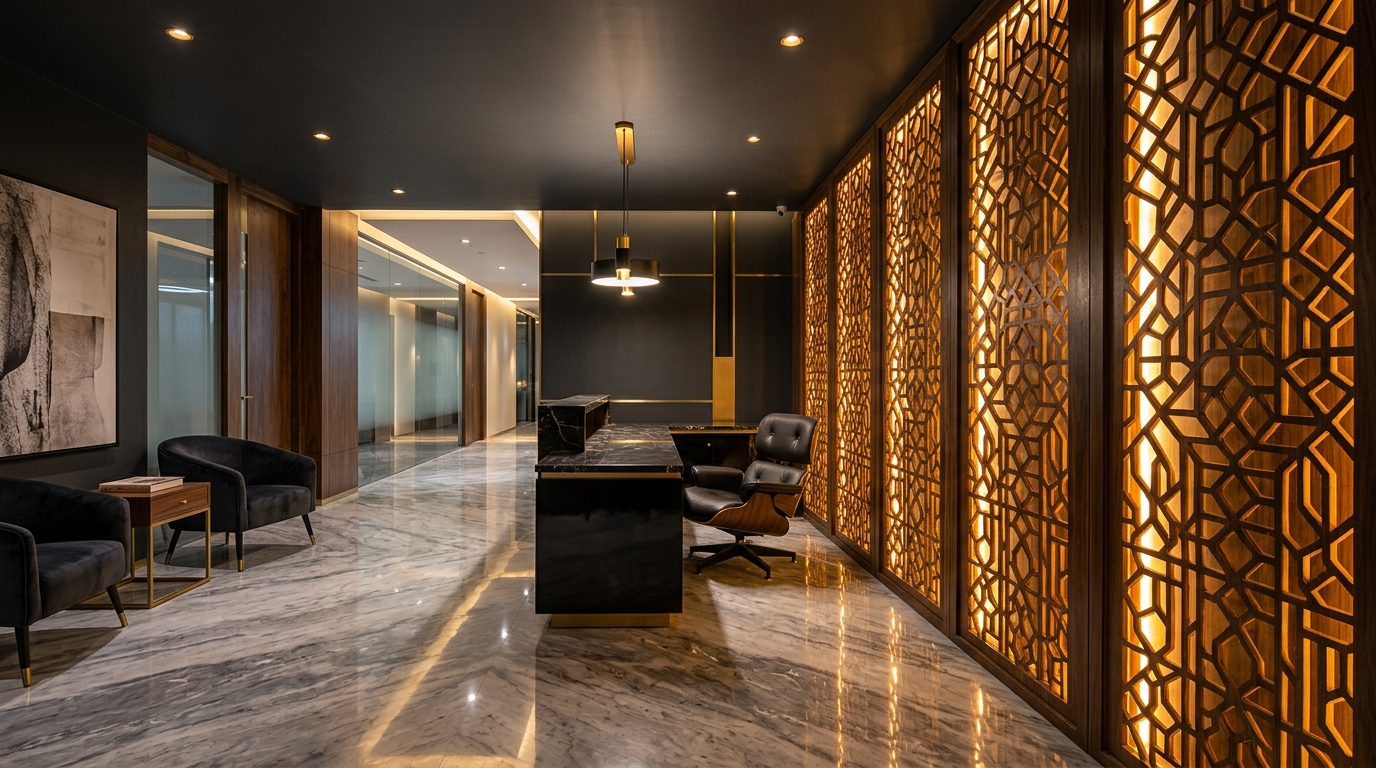
Walk into most offices and the walls tell you nothing. Painted beige, maybe a motivational poster hanging at a slight angle, and a reception desk that looks like it came from a government surplus sale. Now imagine walking into the same office after a proper interior renovation, where the back wall of the reception area has a precision CNC-cut MDF jali panel with the company logo carved directly into it, backlit with warm amber LEDs. The difference is not subtle. It is the kind of first impression that stays with a client long after the meeting is over.
That is exactly why interior designers, architects, and business owners across India are actively searching for the best MDF jali design for office spaces. A well-chosen decorative wall panel does several things at once. It brands the space, breaks up the visual monotony of flat walls, introduces texture and depth, and in many cases even helps with acoustics in open-plan floors.
At Eish CNC Designs, we work with corporate clients, co-working spaces, law firms, IT companies, and clinics in Indore and across Madhya Pradesh. Through that work, we have developed a clear picture of which panel styles actually perform in professional environments. This guide covers all of it, from pattern selection and material choice to finishing, pricing, and installation, so you can make a genuinely informed decision for your next office project.
Why MDF Jali Panels Work So Well in Office Spaces
MDF jali panels give offices what paint and glass simply cannot: architectural texture with zero structural complexity. CNC-cut panels are precise, consistent, and cost-effective, and they carry a brand identity in a way that generic wall treatments never will.
Here's the thing about modern office design. Open-plan floors have become the standard, which is great for collaboration but difficult for visual interest. When every wall is the same flat surface, the space feels institutional. You need elements that create visual rhythm without breaking the open feel. That is where a CNC-cut office MDF jali panel earns its keep.
MDF, or Medium Density Fibreboard, is the preferred substrate for CNC routing in India for a very practical reason. It has no grain. Unlike solid wood, which can split along the grain during intricate cutting, MDF routes in any direction with equal precision. A CNC machine can carve a company logo with 0.5mm detail accuracy into an MDF board, something no manual carpenter can replicate consistently. The result is a panel where every edge is clean, every corner is sharp, and the pattern is identical across panels if you need multiples for a long wall.
Beyond aesthetics, MDF panels are easy to relocate. Offices redesign frequently. A panel mounted on a French cleat system can be moved to a new wall in an afternoon. Glass partitions require professional dismantling. Solid wood walls require demolition. An MDF jali screen? You unscrew four bolts and carry it to the next floor.
Top MDF Jali Design Styles for Office Reception Areas
The five most effective MDF jali styles for office reception areas are geometric lattice panels, custom 3D logo panels, linear slatted panels, Moroccan arabesque screens, and frosted acrylic-backed jali dividers. Each one suits a different brand personality and interior style.
Geometric Lattice Panels
Clean lines, repeating shapes, no ambiguity. Geometric lattice panels are the workhorse of corporate interior design. Hexagons, squares, diamonds, and interlocking chevrons work across virtually every industry, from finance to technology to healthcare. These patterns say "order" and "precision" without trying too hard. For law firms and consulting offices that want a polished look without appearing frivolous, a geometric CNC panel in a matte white or dark charcoal finish is almost always the right call.
Geometric patterns are also the most cost-effective option. Because the shapes are simple and repetitive, CNC MDF cutting time is relatively short. Machine time is a major component of the price for custom panels, so a geometric lattice is often 30 to 40 percent cheaper than an equally sized floral or arabesque design.
Custom 3D Logo and Brand Panels
This is the category that gets the most attention from corporate clients. A 3D relief panel with the company logo carved in raised relief, mounted flush on the reception wall and backlit, is genuinely one of the most powerful branding tools available in interior design. It is also far more affordable than most businesses expect.
The process works like this. Your logo file, ideally in vector format such as an AI or SVG file, is imported into the CNC software. The machine carves the logo in raised relief on an 18mm or 25mm MDF board, typically removing the background to a depth of 8 to 12mm. The panel is then primed, finished in a PU paint or metallic spray, and mounted on a spacer bracket so it sits 30 to 50mm off the wall. LED strip lights inserted behind the panel create a halo glow around the logo. The total effect is a reception wall that looks like it belongs in a top-tier headquarters, regardless of the actual office size.
For offices that want a subtler version, a flat logo cutout on a geometric or slatted background panel works beautifully as well. You get the brand presence without the full three-dimensional drama.
Linear Slatted Wall Panels
Slatted wood panels have become one of the most searched-for office interior elements in India over the last two years. The appeal is easy to understand. Vertical slats add warmth to a space that would otherwise feel cold and corporate, they break up the flat wall surface with shadow lines that shift throughout the day, and they pair naturally with timber furniture, warm concrete floors, and ambient pendant lighting.
For offices, slatted MDF panels are typically installed behind reception desks, along corridor walls, or as the feature wall in conference rooms. When an acoustic felt backing is added behind the slats, the panel also contributes to sound control in open-plan environments. This is an especially practical benefit for IT companies and call centres where noise management directly affects productivity.
You can explore our full range of MDF jali designs and services to find slatted panel options that match your office interior palette.
Moroccan and Arabesque Screens for Office Dividers
Not every office wants to look like a tech startup. Architecture firms, hospitality management companies, luxury retail offices, and boutique agencies often prefer something with more character. For these environments, Moroccan geometric screens and arabesque floral jali panels add genuine personality to the space.
When used as free-standing office cabin dividers or corridor screens, intricate jali patterns create visual separation without building walls. Light passes through the cutouts, keeping the space bright. The pattern becomes a conversation piece. In open-plan offices where different teams sit close together, a jali screen provides psychological separation and privacy without the claustrophobic feeling of a solid partition.
Our CNC cutting design for partition guide covers the structural requirements for free-standing screens in detail, including frame material choices and weight distribution for tall screens.
Office MDF Jali Design Comparison Table
Here's a quick reference to help you choose the right panel style for your specific office environment:
| Panel Style | Best For | MDF Thickness | Approximate Cost Range | Key Benefit |
|---|---|---|---|---|
| Geometric Lattice | Finance, IT, healthcare | 12mm | ₹150-250 per sq ft | Most affordable, highly versatile |
| 3D Logo Relief Panel | Reception branding | 18mm-25mm | ₹400-800 per sq ft | Strongest brand statement |
| Linear Slatted Panel | All office types | 12mm slats on 6mm base | ₹180-300 per sq ft | Warmth, texture, acoustic benefit |
| Moroccan/Arabesque Screen | Boutique and design offices | 12mm-18mm | ₹250-450 per sq ft | High visual impact, unique character |
| Acrylic-Backed Jali Divider | Open-plan separation | 12mm MDF + acrylic | ₹300-550 per sq ft | Privacy with light transmission |
Material Choices: MDF vs HDHMR for Office Panels
Standard MDF is ideal for interior office environments with proper air conditioning. For offices with high humidity, such as ground-floor spaces or coastal locations, HDHMR (High Density High Moisture Resistance) boards are the more durable choice and should be specified from the start.
Most interior offices in Indore work perfectly well with standard MDF panels. If your office is air-conditioned for the majority of the year, standard MDF will hold its shape and finish for a decade without any issues. The surface takes paint well, the edges after CNC routing are smooth, and the material is readily available at consistent quality from local board suppliers.
Where standard MDF fails is when exposed to consistent moisture. Ground-floor offices in older buildings, server rooms with poor humidity control, and reception areas near main entrances that get rain splash during the monsoon season can all cause standard MDF to swell at the edges. Once MDF swells, the edges lift away from the paint film and the board cannot be repaired without replacement.
For these environments, specify HDHMR boards from the beginning. Our detailed comparison in the MDF vs HDHMR guide breaks down the cost difference and performance gap between the two materials across different installation conditions. HDHMR costs roughly 15 to 20 percent more per sheet but can save you the entire cost of panel replacement if moisture is a factor at your site.
How to Create a Backlit MDF Reception Panel
A backlit office reception panel uses LED strip lights installed between the wall and the MDF panel, separated by a 40 to 60mm air gap. The light washes through the carved cutouts to create a glowing effect that works both in daylight and after dark.
The backlit reception panel is the single most impactful upgrade available for an office lobby, and the installation method is simpler than most people assume. You don't need anything exotic. What you need is a clean wall, a set of aluminium or wooden standoffs cut to the correct depth, your LED strip lights, and the CNC-cut MDF panel itself.
The standoffs hold the panel away from the wall by 40 to 60mm. Your electrician routes the LED strip power cable through a small hole in the wall, runs the strips around the perimeter of the wall cavity, and connects to a controller. The MDF panel mounts over the top using the standoffs. When the LEDs are on, the light bounces off the wall surface, fills the cavity, and pushes outward through every cutout in the jali pattern. If you have a 3D logo carved into the panel, the raised portions catch the light differently from the carved grooves, creating a natural three-dimensional shadow play that flat printed logos can never achieve.
For offices that want lighting control, a colour-changing LED controller allows the reception panel to shift from warm white during the day to a brand-colour accent in the evening. Several of our clients in Indore have matched their LED colour to their brand's hex code, creating a completely cohesive brand environment from the moment a visitor walks through the door.
CNC Cutting Design for Office Cabin Partitions
Office cabin partitions made from CNC-cut MDF jali panels divide workspaces without eliminating natural light. A 12mm jali partition in an aluminium frame is structurally stable, visually lightweight, and far less expensive than glass partition systems.
Glass partition systems are popular in modern offices for their clean look and light transmission, but they come with significant costs and practical drawbacks. Glass scratches. Glass shows every fingerprint. Glass requires specialist installation and, if a panel cracks, specialist replacement. A CNC-cut MDF partition costs a fraction of the equivalent glass area and can be repainted or replaced by any competent carpenter.
When designing MDF jali partitions for office cabins, the key structural decision is the frame. For fixed partitions, a steel square tube frame welded to the floor plate provides the best rigidity. For modular or relocatable partitions, a heavy-gauge aluminium extrusion frame with lock joints allows the entire system to be dismantled and reassembled in a new configuration without any damage to the panels. This matters enormously in leased office spaces where the next lease cycle may require a completely different floor plan.
Take a look at the 2D CNC cutting services we offer for flat jali screens and partition panels if you need standard geometric patterns at competitive pricing. For fully custom designs with complex pattern work, our bespoke cutting service handles files from any major CAD platform.
Finishing Options That Make a Difference in Corporate Environments
The right finish protects your MDF office panel against everyday scuffs, UV yellowing, and fingerprint marks. PU (Polyurethane) paint and Duco finish are the industry standard for corporate applications. Veneer wrapping adds natural warmth for boardrooms and executive offices.
Raw MDF cannot survive in an office environment without a proper finish. The surface is porous, soft, and highly absorbent. A coat of primer seals the surface, but for a truly durable office panel you need at least two coats of PU paint or Duco over the primer.
PU paint cures to a hard, almost plastic-like film that resists fingerprints and can be wiped clean with a barely damp cloth. It is available in any RAL colour code, so matching your office's existing colour palette is straightforward. The finish comes in full matte, satin, and gloss options. For corporate offices under fluorescent or LED lighting, matte and satin finishes are preferred because they don't create glare.
For executive offices and boardrooms where the panel needs to convey warmth rather than just professionalism, a real wood veneer or a high-quality wood-grain laminate applied over the flat sections of the panel, leaving the jali cutouts open, gives the space the feel of solid wood joinery at a significantly lower cost. If you are curious about how CNC routing works on solid wood versus MDF, our MDF vs plywood guide explains the routing behaviour difference between the two materials in practical terms.
Choosing the Right CNC Partner for Your Office Project
The quality of a CNC-cut office panel depends entirely on the quality of the machine doing the cutting and the experience of the team reading the design file. A poorly calibrated router produces fuzzy edges, uneven depths, and panels that require extensive manual sanding before painting. Eish CNC Designs uses heavy-duty industrial routers to produce office-grade panel quality consistently.
Not all CNC cutting services in India produce the same result. A local workshop with a low-cost hobby-grade router may quote 40 percent less than an industrial facility, but the output quality difference is visible immediately. Hobby routers vibrate during cutting, which produces slightly rough edges and inconsistent depth in the carving. Under direct office lighting, these imperfections become visible even after painting.
Industrial CNC routers with vacuum hold-down beds and linear bearings produce a fundamentally different level of edge quality. The cut edges are so clean that they require minimal sanding before primer application. Carved areas have consistent, repeatable depth. Panels cut to specific dimensions are accurate to within half a millimetre, which means they fit the installation grid without adjustment on site.
At Eish CNC Designs, we work directly with interior designers, project contractors, and business owners in Indore on commercial MDF projects. We accept DXF, SVG, DWG, and AI vector files. If you have a sketch or a rough reference image rather than a finished vector file, our design team can prepare the cutting file from your brief. You can see examples of our commercial work in our guide on CNC cutting panels for architects to understand how we handle multi-panel commercial projects from file to delivery.
We also supply finished panels ready for direct installation, or raw-cut panels for finishing by your own contractor team. Whichever workflow suits your project timeline, we adapt to it.
Conclusion
The best MDF jali design for office is not one fixed pattern. It depends on your brand personality and the message your space needs to send. Analytical firms do well with clean geometric lattice panels. Brands that want a strong lobby statement should invest in a backlit 3D logo panel. Creative or hospitality offices work best with slatted wood or arabesque screens. Whatever your brief, the right panel type, thickness, and finish can be matched to your space. Share your floor plan and requirements with our team at Eish CNC Designs and we will get you a free quote within 24 hours.
Frequently Asked Questions
-
Which is the best MDF jali design for an office reception?
For office receptions, geometric lattice panels and custom 3D logo panels are the most popular MDF jali designs. Geometric patterns convey professionalism and order, while a backlit logo panel turns the reception wall into a powerful brand statement. Both designs can be CNC cut from 12mm MDF and finished in PU paint or veneer.
-
What thickness of MDF is best for office wall panels?
For office partition screens and decorative wall panels, 12mm MDF is the standard recommendation. It provides enough structural rigidity to stand without flexing, while remaining light enough for standard wall mounting. For 3D relief panels with deep carving, 18mm or 25mm MDF is preferred so the design has visible depth.
-
How much does an MDF office reception panel cost in Indore?
The cost of an MDF office reception panel in Indore depends on the panel size, design complexity, and finish. A simple geometric jali panel for a small wall starts from approximately ₹3,000 to ₹6,000. A full reception wall with backlit custom logo carving and PU finish can range from ₹15,000 to ₹60,000 or more depending on the dimensions.
-
Can MDF jali panels be used as office cabin partitions?
Yes. CNC-cut MDF jali panels are widely used as office cabin partitions. They divide workspaces without fully blocking light, maintaining an open and airy feel. When paired with a steel or aluminium frame, a 12mm or 18mm MDF jali partition is structurally sound and easy to relocate during office redesigns.
-
Are slatted MDF wall panels good for office acoustics?
Slatted MDF wall panels do provide some sound absorption, especially when an acoustic foam or felt backing is installed behind the slats. The gaps between slats disrupt sound wave reflection, reducing echo in open-plan offices. For conference rooms, adding an acoustic backing to the slatted panel significantly improves speech clarity.
-
What finish is best for an office MDF jali design?
PU (Polyurethane) paint and Duco finish are the top choices for office MDF panels. Both create a hard, durable surface that resists fingerprints and scuffs. For a warmer look, veneer or wood-grain laminates are excellent. Matte finishes reduce glare under office lighting, making them more comfortable throughout the workday.
-
How long does it take to get a custom office MDF panel made in Indore?
At Eish CNC Designs in Indore, a standard CNC-cut MDF office panel is typically ready within 3 to 7 working days after the design file is confirmed. Large custom projects with multiple panels, complex 3D relief carving, or special finishing requirements may take 10 to 15 working days.