
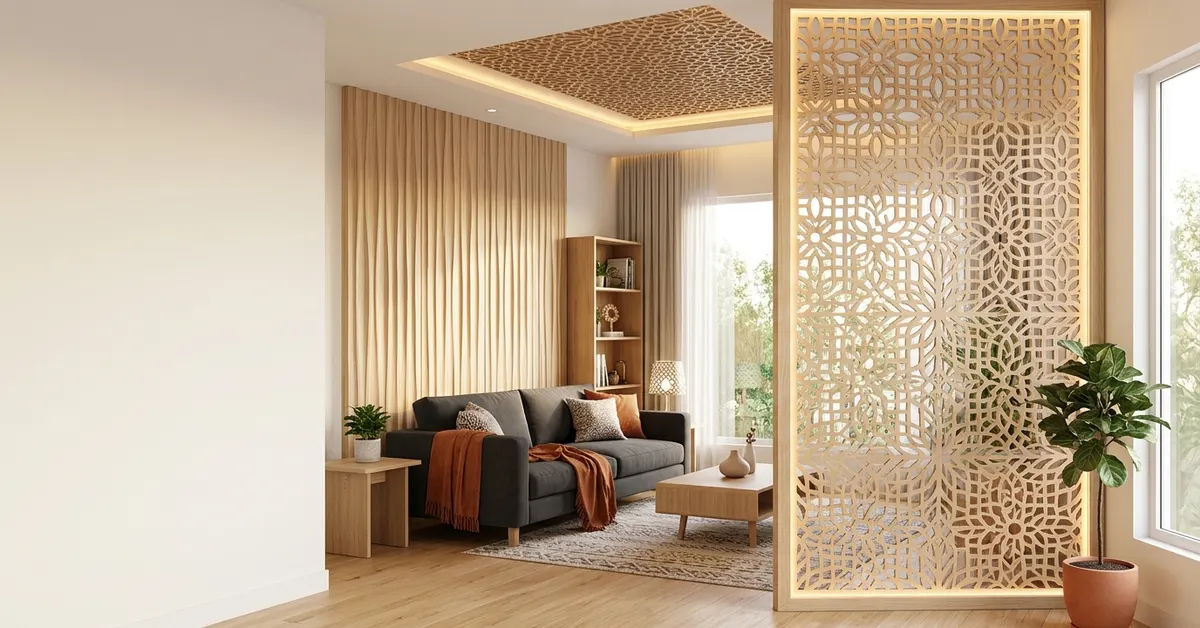
A plain MDF sheet doesn't look like much. Run a CNC router over it with the right pattern, and the same sheet becomes the first thing a guest notices in your living room. That jump is why MDF CNC cutting designs have moved out of temple corners and into hall partitions, ceilings, wardrobes and shop fronts across Indore. The worry we hear most is simple: which patterns look good, and which ones will chip, swell or look dated in a year? Our CNC cutting MDF services in Indore team answers that on the shop floor almost every day.
This guide covers more than 20 modern ideas for interiors and furniture, grouped by where they go in a home or office. You'll also find the right board thickness for each use, a moisture sealing routine and straight answers to the questions people ask before ordering. If you want ready patterns first, browse our MDF jali designs and come back here for the thinking behind them.
Every idea below comes from work we have cut at our workshop on Dhar Road. None of it is theory.
MDF CNC Cutting Designs: 20+ Modern Ideas for Interiors and Furniture
MDF CNC cutting designs are decorative patterns routed into Medium Density Fibreboard by a computer controlled router. They work as room dividers, wall panels, ceiling inserts, mandir screens and furniture fronts in homes, offices and shops, in both traditional floral and modern geometric styles.
MDF CNC cutting designs give contemporary interiors and custom furniture a flexible way to add pattern, shadow and depth, whether the space is a flat, a villa, a clinic or a showroom. The reason is the board itself. Medium Density Fibreboard has a smooth, grain free surface and the same resin mix from edge to edge. A fast router bit meets identical material at every point, so it can carve detailed geometric patterns, traditional floral lattice motifs and complex parametric wall art with clean definition.
Plywood fights back with grain direction and hollow cores. Solid wood splits along its grain. MDF just cuts. That is why most jali work in modern Indian apartments starts as an MDF sheet.
Why MDF Works So Well for CNC Cutting Designs
MDF suits CNC cutting because it has no grain, a uniform density and a smooth face that takes paint, PU polish, veneer or laminate evenly. It routes fine slots without tearing and costs less than plywood or HDHMR for decorative work.
Three things matter most when you pick a board for pattern work. The first is edge quality. On MDF, a clean cut needs only a light sanding before primer. The second is detail. Slots as narrow as 3mm and thin bridges between cutouts stay intact because the fibres run in every direction. The third is finish. A sprayed PU or Duco coat sits flat on MDF and hides nothing, which is exactly what you want on a pattern with hundreds of edges.
If you have been searching for an MDF jali design, a CNC jali design for your hall or a jali design for wall decor, you will notice the same names keep coming up: MDF partition design, mandir jali design, false ceiling jali design and 3D wall panel design. They are all one CNC cutting design process applied to an MDF board design that suits the location. Once you know the five groups below, any pattern you find online can be matched to the right thickness, finish and fixing method.
A pattern that looks great on a screen can still fail on the wall if the bridges are too thin or the cutouts are too large for the board. Our designers check this before a single sheet goes on the machine.
The catch is moisture. Raw MDF absorbs humidity from the air, so the success of any design depends on choosing the right board density and sealing every routed channel completely. We cover that in a separate section below. Let's get to the ideas first.
23 Modern MDF CNC Cutting Designs for Homes, Offices and Furniture
The best MDF CNC cutting designs fall into five groups: partitions, wall panels, false ceilings, mandir screens and furniture fronts. Each group has patterns that suit a particular board thickness, lighting style and room size.
Room Divider and Partition Designs
MDF jali partitions divide a room without blocking light or airflow. A 12mm board in a framed panel is the standard choice, and warm white LED strips behind it turn the cutouts into a glowing pattern.
- Geometric lattice divider between the living and dining area, framed in 12mm MDF with a matt PU finish.
- Floral jali foyer screen that hides the main door from the sofa without making the entrance feel closed in.
- Backlit staircase screen with a vertical leaf pattern, lit from the floor by a slim LED channel.
- Narrow slat partition for studio flats, clinics and offices, with long thin cutouts that look clean and modern.
- Honeycomb divider for cafes and reception areas, cut in repeating hexagons that photograph well.
If you want more on how these panels perform in real rooms, our guide to interior CNC cutting design for partition goes through layouts, frames and fixing methods.
Wall Panel and Feature Wall Designs
Wall panels in MDF add texture to a plain wall. Deeper 3D carvings use 18mm board, while light jali overlays on a painted backing work in 8mm to 12mm. Panels are fixed on battens or a plywood base.
- 3D textured wave panel behind the sofa, carved in flowing lines that change with the daylight.
- Parametric wall art with overlapping curves, cut as one large mural or as separate tiles.
- Acoustic wall diffuser tiles for home theatres, podcast rooms and studios, cut in varying depths to scatter sound.
- Fluted TV unit backdrop with evenly spaced grooves and a hidden LED line at the top.
- Arabesque cladding for a reception wall, cut in a repeating Islamic star pattern and painted in one bold colour.
Planning a feature wall? Our detailed notes on MDF wall panel designs compare patterns, fixing and finish options.
False Ceiling and Ceiling Insert Designs
Ceiling designs in MDF use thin 6mm to 8mm boards to keep weight low. They are framed into a gypsum or POP false ceiling and usually lit from the edge with cove lighting.
- Jali insert above the dining table, framed in a gypsum border with warm cove lights around it.
- Coffered jali panels in a hall ceiling, arranged in a grid of equal squares.
- Mandala centrepiece in a drawing room, cut in a radial pattern with a light fitting at the centre.
- Bedroom ceiling border strip with a minimal geometric cut that adds interest without feeling heavy.
Weight, fixing and lighting all need care at ceiling height. We explain each step in our guide to MDF jali design for ceiling.
Mandir and Temple Screen Designs
Mandir designs in MDF use fine traditional patterns, usually in 12mm to 18mm board, with LED backlighting behind the jali. Painted, polished or veneered finishes are all common.
- Backlit mandir screen with an arch and trellis, glowing softly behind the idols.
- Traditional floral lattice mandir doors that open on small brass hinges.
- Om or Ganesh motif backdrop cut as a single large symbol with a lattice border.
- Wall mounted mini temple with jali side panels and a carved top canopy.
Our page on MDF jali design for mandir shows more patterns, sizes and finishes for home temples.
Furniture and Cabinet Front Designs
MDF furniture fronts use 18mm prelaminated or paint grade board. Patterns work best on wardrobe doors, shutters, headboards and console fronts, where the router can cut grooves, handles and cutouts in one pass.
- Sliding wardrobe door accents, with a jali strip over a mirror or fabric backing.
- Patterned kitchen shutters with a groove detail that replaces a separate handle.
- Floral outline headboard in a master bedroom, painted in a soft, deep colour.
- Shoe cabinet and console front with jali cutouts that let air move through.
- Display unit backs with a quiet geometric pattern behind books and decor.
For kitchens in particular, our MDF kitchen cabinet doors in Indore page covers board grades, edge sealing and finishes.
Best MDF Thickness and Board Type for Each Design
Use 6mm to 8mm MDF for ceilings and light jali, 12mm for partitions and mandir screens, and 18mm for 3D carved panels and furniture fronts. Choose moisture resistant board anywhere humidity is likely.
Here is a quick reference we share with designers and carpenters before they place an order:
| Design Type | Thickness | Board Type | Finish Tip |
|---|---|---|---|
| Room dividers and screens | 12mm | Standard or moisture resistant MDF | Seal edges, then PU paint |
| 3D wave and textured panels | 18mm | High density MDF | Sand curves, spray two coats |
| Ceiling inserts | 6mm to 8mm | Standard MDF | Light primer and matt paint |
| Mandir screens | 12mm to 18mm | Moisture resistant MDF | Polish or veneer, with LED behind |
| Acoustic diffuser tiles | 18mm | High density MDF | Fabric backing optional |
| Furniture fronts | 18mm | Prelaminated or paint grade MDF | Edge band all cut sides |
How to Protect MDF CNC Cutting Designs from Moisture
Seal every face and every routed edge of an MDF panel with primer and paint. Raw MDF absorbs atmospheric moisture, and unsealed cut channels are where swelling starts.
Here's the thing most buyers miss. A jali panel has far more edge than face. Every curve, slot and bridge is a raw edge, and raw edges drink water. If you paint only the front, the panel can still warp in the monsoon.
- Prime the front, the back and all routed channels, using a spray gun so the paint reaches inside the pattern.
- Sand lightly between coats to remove raised fibres.
- Apply two finish coats of PU, Duco or enamel paint.
- Keep panels at least a few centimetres off the floor and away from wet walls.
- Choose moisture resistant MDF or HDHMR for kitchens, balconies and coastal homes.
Follow these five steps and a well made panel will hold its shape for years in a normal indoor setting.
How Eish CNC Designs Cuts MDF Designs in Indore
Eish CNC Designs cuts raw and prelaminated MDF at its workshop in Gurunanak Timber Market on Dhar Road, Indore. It offers job work with your own sheets or a complete service with material supply and CNC cutting.
At our workshop, skilled technicians process raw and prelaminated MDF sheets with calibrated spindle speeds, specialised compression bits and dust extraction routing that eliminates edge fuzzing during production. Compression bits press the top and bottom fibres inward as they cut, which gives a crisp edge on both faces of the sheet.
Our shop floor supports more than twenty modern interior concepts, including 2D decorative grilles, 3D textured wave panels, acoustic wall diffuser tiles and custom furniture fronts. Local fabricators, interior decorators and architects use these services on residential and commercial projects across the city.
We offer two ways to work with us. Under job work, you provide your own MDF material and we cut it to your drawing. Under the complete service, we supply the board and deliver finished, precision cut panels. Either way, you submit 2D vector files in DXF, CDR or Adobe Illustrator formats. If you only have a sketch or a photo, our in house designers will turn it into a machine ready toolpath with you.
You can also read more about the formats we accept on our 2D CNC cutting services page.
Conclusion
So, what makes MDF CNC cutting designs worth the investment? Automated CNC precision, paired with careful finishing, turns a flat engineered board into a working architectural part. You get cost effective decoration that stays dimensionally stable in partitions, furniture components and ceiling panels, for homes, shops and offices throughout Madhya Pradesh. Choose the right thickness, seal every edge and pick a pattern that suits the room.
Have a drawing, a sketch or just an idea? Send it over and we'll recommend the right board and give you a quote within 24 hours. Contact Eish CNC Designs and let's plan your project.
Frequently Asked Questions
-
What are the best MDF CNC cutting designs for a living room?
The most popular choices are a backlit geometric jali partition, a 3D wave panel behind the sofa, a fluted TV unit backdrop and a decorative ceiling insert above the seating area. Pick one hero piece and keep the other surfaces plain so the pattern gets attention.
-
Which MDF thickness is best for CNC jali panels?
Use 12mm MDF for standalone partitions and screens, 8mm for ceiling inserts and light wall jali, and 18mm for 3D carved panels and furniture fronts. Thicker boards hold fine bridges better and stay flat over larger sizes.
-
Can MDF CNC cutting designs be used in a bathroom or kitchen?
Standard MDF should stay out of wet areas. For kitchens and humid rooms, choose moisture resistant MDF or HDHMR and seal every routed channel with primer and paint. Even then, keep the panel away from direct water spray.
-
Which file formats are accepted for MDF CNC cutting?
Eish CNC Designs accepts 2D vector files in DXF, CDR and Adobe Illustrator formats. If you only have a sketch or a reference photo, our in house designers can convert it into a machine ready drawing and toolpath.
-
Can I supply my own MDF sheets for CNC cutting?
Yes. Eish CNC Designs offers job work, where you bring your own MDF sheets and we cut them to your drawing. You can also choose the complete service, where we supply the board and deliver finished, cut panels.
-
How do I protect MDF jali panels from moisture?
Apply primer to the face, the back and every routed edge, then finish with two coats of PU or enamel paint. Unsealed cut edges absorb humidity first, so the inside of each pattern needs full coverage.