
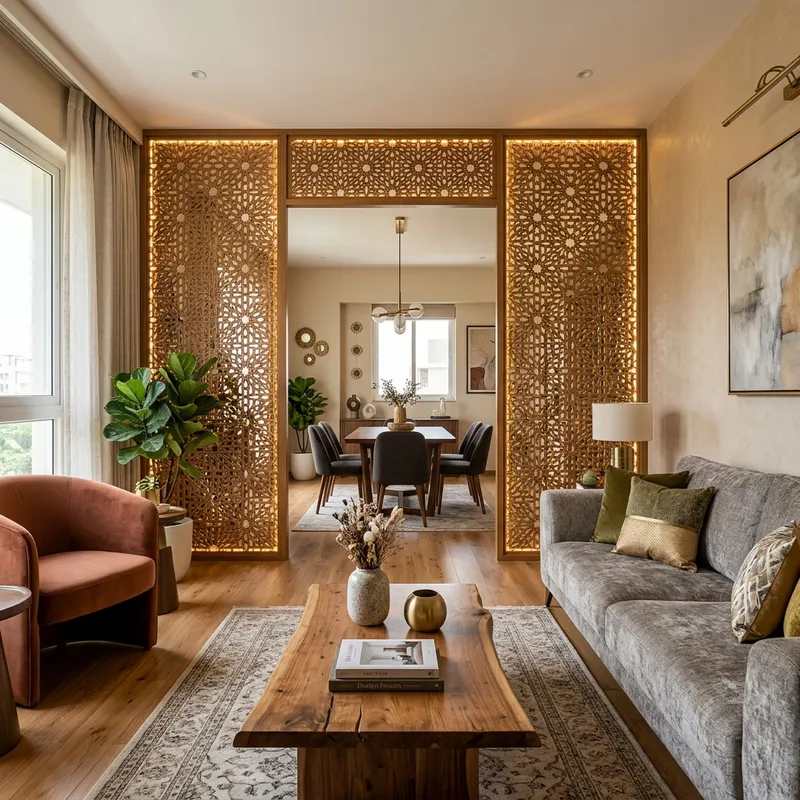
The living room acts as the heart of the home. It is where families gather, guests are entertained, and daily life unfolds. Because of this central role, homeowners constantly look for ways to add visual interest, texture, and character to their living spaces without cluttering the floor plan. One of the most effective and affordable ways to achieve this is through an mdf jali design for living room.
Jali, which translates to a latticed screen, has deep roots in Indian and Islamic architecture. Historically carved from stone or solid wood, these perforated screens provided ventilation, privacy, and a play of light and shadow. Today, modern CNC technology allows us to recreate these intricate patterns using Medium Density Fibreboard (MDF). This engineered wood product has revolutionised interior design by offering high precision at a fraction of the cost of traditional materials.
Medium Density Fibreboard is manufactured by breaking down hardwood or softwood residuals into wood fibres, combining them with wax and a resin binder, and forming panels under high temperature and pressure. Unlike solid wood or plywood, MDF has no grain direction and is completely uniform throughout. This consistency makes it the perfect candidate for CNC routing and laser cutting. When a CNC bit carves through MDF, it leaves a smooth, crisp edge that requires minimal sanding and takes paint beautifully.
Whether you want to create a subtle mdf jali partition for living room between your living and dining areas, add a decorative backdrop to your television unit, or introduce a patterned ceiling feature, MDF jali offers unmatched versatility. In this guide, we will walk through everything you need to know, from pattern selection and board thickness to finishing techniques, lighting, and realistic cost expectations.
Why Choose MDF Jali for Your Living Room?
MDF combines the sharpest CNC-cut edges available in any wood-based panel material with a smooth, paint-ready surface, making it the default choice for living room jali work across Indore.
There are several reasons why architects and interior designers consistently favour MDF for living room installations over other traditional materials.
Cost-Effectiveness and Budgeting
Solid wood carving is highly labour-intensive and requires expensive raw materials. MDF provides the same visual impact for a fraction of the cost. Because the cutting is done by computer-controlled machines, the labour hours are drastically reduced. A large solid teak partition could cost lakhs of rupees, whereas an MDF alternative can achieve the same visual scale for a tenth of the price.
Limitless Design Flexibility
Because CNC machines operate using vector files, literally any design you can draw on a computer can be cut into the board. Whether it is a CNC jali design inspired by Mughal palace screens or a minimalist geometric grid, the machine will cut it with perfect accuracy. You are not limited by the skill of a manual carver. You can even create custom monograms or incorporate family crests into the design.
Smooth Finishing Capabilities
The lack of wood grain means edges do not splinter. This is crucial for a jali screen, where a single panel might have hundreds of cutouts and inner edges. A smooth edge means the paint goes on evenly, resulting in a premium, polished look that stands up to close inspection from guests.
Quick Turnaround
Once the design is finalised, a CNC machine can cut a standard 8x4 foot jali panel in a matter of hours. This rapid production time keeps your interior project on schedule, unlike manual carpentry which can take weeks. This speed is vital for commercial renovations or home fit-outs working under strict deadlines.
The Architectural History of Jali
Jali originated in ancient Indian and Islamic palace architecture as a functional ventilation and privacy screen. Today, CNC technology recreates those same intricate perforated patterns in MDF for modern living rooms.
To fully appreciate the beauty of an mdf jali design for living room, one must look at the history of the jali itself. Originating in ancient Indian and Islamic architecture, the jali was first a functional necessity before becoming a decorative element. In the scorching heat of the Indian subcontinent, massive stone walls trapped heat. By piercing these walls with intricate geometric patterns, architects allowed cool breezes to flow through the building while keeping the harsh sunlight out.
The perforated screens also served a social purpose in royal courts, allowing women to observe public proceedings without being seen themselves, creating a sense of privacy without isolation. The intricate play of light and shadow cast by a jali as the sun moved across the sky became a defining feature of palace architecture.
Today, we no longer need jali for ventilation in our air-conditioned living rooms. However, the aesthetic appeal remains stronger than ever. The modern mdf jali design for living room pays homage to this rich architectural heritage while adapting it for contemporary urban apartments.
Top Placements for MDF Jali in Open Floor Plans
MDF jali works best as a living-dining partition, a backlit TV unit backdrop, a puja corner screen, a false ceiling accent, or a window treatment. Each placement transforms a plain surface into a layered design feature.
The versatility of an mdf jali design for living room means it works in numerous configurations. Here are the top placements we see in modern Indian homes.
1. Living and Dining Room Partitions
Modern apartments frequently feature an open floor plan where the living area flows directly into the dining space. While this makes the home feel larger, it can lack definition. A ceiling-to-floor wooden jali partition physically separates the two zones without blocking light or airflow. It provides psychological separation while maintaining the spacious feel of an open plan.
2. TV Unit Backdrops
The television unit is often the focal point of the living room. Instead of mounting the TV on a plain painted wall, designers use a TV unit jali design as a textured backdrop. The MDF jali panel is mounted slightly away from the wall with hidden LED strips behind it, casting beautiful shadows and creating a cinematic viewing environment.
3. Puja Corner Screens
If your living room doubles as your prayer area, integrating a mandir gracefully can be challenging. Many homeowners enclose the prayer niche with folding MDF jali doors or flank it with decorative screens. This provides privacy for the mandir while allowing the sound of bells and the scent of incense to drift into the room. For detailed religious patterns, see our guide on the MDF jali design for mandir.
4. False Ceiling Accents
A plain gypsum ceiling can feel sterile. By inserting a laser cut MDF panel into a ceiling recess and backing it with translucent acrylic and warm LED lighting, you create a glowing skylight effect. This MDF false ceiling design draws the eye upward and adds a layer of luxury to the entire room.
5. Window and Balcony Treatments
In dense urban areas, the view from a living room window might be an adjacent building. Installing an MDF jali screen over the window diffuses harsh incoming light and turns an unpleasant view into a decorative feature, similar to traditional Rajasthani architecture.
6. Staircase Enclosures
For duplex homes where the staircase is visible from the living room, a full-height jali screen for living room acts as a stunning architectural balustrade. It provides safety while adding a massive vertical design element that draws the eye upward through the space.
Pattern Selection and Aesthetic Impact
Geometric grids suit minimalist homes, Arabesque suits warm luxurious interiors, traditional floral suits heritage furniture, and parametric waves suit high-end contemporary apartments. The pattern should match both the room size and your viewing distance from the panel.
The pattern you choose dictates the entire mood of the room.
Geometric and Modern Grids
For contemporary living rooms with clean lines and minimal furniture, geometric patterns are the best choice for a decorative MDF panel. Intersecting circles, honeycomb hexagons, abstract triangles, and strict vertical lines look highly structured and pair well with neutral colour palettes. They add discipline and order to the space.
Arabesque and Moroccan Designs
These patterns feature intricate, repeating stars and interlocking curves. They bring a rich, exotic feel to the living room and look spectacular when heavily backlit. Ideal for homes that feature warm colours, brass accents, and rich textiles, this style is heavily favoured in luxury villas.
Traditional Floral and Organic
Drawing inspiration from historical Indian palaces and temples, floral jali patterns feature flowing vines, lotus motifs, and organic curves. These designs soften the hard edges of a modern living room and work beautifully in homes with traditional wooden furniture.
Parametric and Abstract Waves
Parametric designs use computer algorithms to create flowing, wave-like patterns that appear to shift as they move across the board. These are highly modern and often painted in stark white or deep charcoal to emphasize the dramatic curves. They serve as aggressive artistic statement pieces in luxury apartments.
Choosing the Right Board Thickness
Use 6mm MDF for wall-backed applications, 8mm to 12mm for framed ceiling or wall panels, and 18mm or above for any freestanding partition that has no structural support behind it.
Selecting the correct thickness for your MDF board is critical for both durability and aesthetics. If the board is too thin, it will warp; if it is too thick, it will look heavy and lose its delicate appearance.
4mm to 6mm is strictly for applications where the board is fully supported on the back, for example, gluing the jali directly onto a solid wall or sandwiching it between two sheets of glass.
8mm to 12mm is the standard thickness for ceiling panels and wall features where the panel is framed. It provides enough depth to show off the cut edges without adding excessive weight for ceiling suspension. This is the most commonly used specification in our CNC cutting MDF services in Indore.
18mm to 25mm is required for freestanding partitions, room dividers, and doors. A partition has no back support, so it relies entirely on its own thickness to remain rigid and resist warping through changing humidity levels. Thicker boards also allow for deeper 3D carving effects. Our CNC Cutting Furniture Indore services use these thicker boards for structural integrity in custom pieces.
Professional Finishing and Painting Techniques
Always seal the porous cut edges of MDF with a primer before applying any topcoat. Spray-applied PU or Duco finishes give MDF a hard, furniture-grade surface that resists scratches, moisture, and UV yellowing.
MDF is essentially compressed paper and wood dust, which means it acts like a sponge when exposed to moisture or liquid paint. Proper finishing is the secret to a long-lasting jali.
Sealing the Porous Edges
The face of an MDF board is smooth, but the cut edges inside the jali pattern are highly porous. Before any topcoat is applied, a primer or a specialized MDF sealer must be sprayed onto the edges and sanded down. This process might need two or three passes until the edge feels as smooth as glass. Skipping this step will result in the final paint soaking in and looking patchy.
Duco and PU Finishes
For living rooms, we strongly recommend a PU (Polyurethane) or Duco finish. These automotive-grade paints are sprayed on in a dust-free booth, creating a hard, plastic-like shell over the MDF that is highly resistant to scratches and moisture. You can choose a high-gloss finish for a glamorous look or a matte finish for subtle elegance.
Veneer and Polish
If you want the look of real wood, you can purchase pre-veneered MDF. After the CNC machine cuts the pattern, the edges are painted a dark brown to mimic burnt wood, and the veneer face is polished. This gives you the warmth of natural wood at a lower cost.
For related finishing approaches, you can explore how panels are treated in our MDF Wall Panel Designs service.
Integrating Lighting for Maximum Impact
Backlighting outlines the jali pattern in silhouette. A frosted acrylic backing creates an even, diffused glow. Front spotlighting highlights the 3D texture through shadow. Use dimmable LEDs to switch between moods.
An unlit jali is just a piece of wood with holes in it. Lighting is what brings the design to life.
Backlighting for Silhouette
The jali is mounted an inch away from a solid wall or ceiling. LED strip lights are placed behind the solid portions of the jali. When turned on, the light bounces off the back wall and glows through the cutouts, outlining the pattern beautifully in silhouette.
Translucent Backing for Diffused Glow
A sheet of frosted acrylic is placed directly behind the MDF jali, and LED lights are placed behind the acrylic. The acrylic acts as a diffuser, turning the entire cutout area into a soft, even light panel. This is the standard setup for false ceiling integrations, as it completely hides the individual LED diodes.
Front Spotlighting for Texture
If the jali is painted a bright colour and mounted against a dark wall, a simple ceiling spotlight aimed at the face of the panel will highlight the 3D texture and cast dramatic shadows onto the wall behind it. This technique is borrowed directly from art galleries and high-end retail environments.
Installation Methods for Different Applications
Freestanding partitions require a solid wood frame. Wall-mounted panels should use hidden French cleats, not face screws. Ceiling panels are fixed to a wooden grid above the gypsum board and filled smooth before painting.
Installing a CNC-cut panel requires precision to ensure it sits flat and perfectly secure.
Framing Freestanding Partitions: A living room partition should never be installed without a solid frame. A teak or pine frame is constructed around the perimeter of the MDF panel, providing structural rigidity and giving floor brackets something solid to grip. Without a frame, a large panel will warp over time.
Z-Clips and French Cleats for Wall Mounting: Do not drill screws directly through the face of the panel. Use French cleats or Z-clips hidden behind the panel. This allows the jali to hang securely on the wall without any visible hardware ruining the design.
Ceiling Suspension Grids: For ceiling installations, a wooden grid is created above the gypsum board. The MDF panels are then screwed into this hidden wooden grid, and the screw heads are filled with putty and painted over so the ceiling looks completely seamless.
MDF vs Solid Wood vs Plywood vs WPC
For dry indoor living rooms that need a premium painted finish, MDF outperforms plywood (which splinters on CNC cuts), WPC (which does not take paint well), and solid wood (which costs far more) in terms of cut quality, surface finish, and value.
Comparing materials helps you make the right choice for your specific living room requirement.
MDF vs Plywood
Plywood is stronger and handles moisture better than MDF. However, alternating veneer layers tend to splinter when CNC-cut, leaving a rough edge that requires hours of sanding. MDF provides a far superior cut finish. For furniture components that need structural strength, our CNC Cutting Furniture Indore services use a mix of materials based on application.
MDF vs WPC
Wood Plastic Composite is completely waterproof and termite-proof, making it the best material for exterior use or wet areas. However, WPC does not take paint as smoothly as MDF. For a premium painted finish in a dry indoor living room, MDF remains the better choice.
MDF vs Solid Wood
Solid wood carving is beautiful and heritage-rich, but vastly more expensive and time-consuming. Solid wood can also crack or warp depending on humidity levels. You can explore solid wood options at our CNC wood carving section, but for large partitions, MDF provides better value and dimensional stability.
MDF vs Metal
Metal screens in mild steel or stainless steel offer an industrial aesthetic and are incredibly strong. They are much heavier and require specialized fabrication. For metalwork requirements, check our CNC metal cutting capabilities.
Maintenance and Longevity Tips
Clean MDF jali only with a dry microfibre cloth or a vacuum brush. Never use wet cloths. Keep the panel away from direct water, humidity, and hard impacts. UV-resistant topcoats prevent paint from yellowing over time.
MDF is highly durable when treated correctly, but it has one major enemy: water.
Never wipe an MDF jali with a wet cloth. If water seeps into a micro-crack in the paint, the compressed wood fibres will absorb moisture and swell irrecoverably. To clean your jali, use a dry microfibre cloth or a soft bristle brush attachment on your vacuum cleaner. For stubborn stains, use a slightly damp cloth, wipe quickly, and immediately dry the area with a clean towel.
Because living rooms are high-traffic areas, position freestanding partitions away from areas where heavy furniture is moved frequently. A hard knock can chip the PU paint on the delicate inner edges of the cutout pattern.
If your living room has large windows facing the afternoon sun, ensure your MDF is painted with a UV-resistant topcoat to prevent the paint from yellowing over the years.
Cost Analysis and Budgeting in India
The three cost drivers for MDF jali in India are board thickness, pattern density (which determines CNC machine time), and the finish type. PU and Duco spray finishes are the most expensive component but are essential for a living room-quality result.
The cost of an mdf jali design for living room depends on three primary factors: the thickness of the board, the density of the pattern, and the type of finish applied.
CNC Cutting Cost: CNC cutting is charged per square foot based on machine running time. A simple geometric pattern that takes ten minutes to cut will cost significantly less than a highly intricate floral pattern that runs the machine for an hour. For more detail on pricing variables, read our CNC Cutting Price in Indore guide.
Material Cost: An 18mm board will cost more than a 6mm board. Always purchase high-density interior grade MDF from reputable brands to ensure a clean, splinter-free cut. Sub-standard boards fray during machining and result in a poor finish.
Painting and Finishing Cost: This is often the most expensive part of the process. A spray-applied high-gloss PU finish done in a dust-free booth can cost more than the cutting and the raw board combined. Do not compromise on finishing. It is what the eye actually sees and what determines the perceived quality of your entire living room.
Combining MDF Jali with Other Materials
Pairing MDF jali with toughened glass creates a clean, washable partition. Metal framing adds an industrial-luxury contrast. Mirror backing doubles the visual size of the room. Acoustic fabric backing improves room sound quality.
An MDF jali does not have to exist in isolation. Combining it with other materials elevates an MDF room divider from a simple board to a luxury interior element.
With Glass: Sandwiching a thin MDF jali between two sheets of toughened glass creates a stunning, easy-to-clean partition. This is perfect for separating a living room from a dusty balcony while maintaining visual transparency.
With Metal Frames: Framing an MDF panel in a slim profile brass or matte black powder-coated aluminum frame provides a striking contrast between the organic wood and industrial metal.
With Mirrors: Mounting a jali panel directly over a mirror creates the illusion of depth. The room appears twice as large, and the jali pattern is reflected back on itself, creating complex visual geometry.
With Acoustic Fabric: If you use the jali as a TV unit backdrop, backing it with acoustic fabric helps absorb sound reflections and improves the acoustics of the living room, reducing echo during movie nights.
Commercial Inspiration for Residential Spaces
Luxury hotels and restaurants use double-height backlit MDF jali as signature design elements. The same technique, scaled to a single living room wall or TV unit, creates an equally dramatic effect in residential spaces.
Luxury hotels frequently use massive, double-height MDF jali panels in their lobbies. You can replicate this look in your living room by running a continuous jali pattern from the floor, up the wall, and across the ceiling. This wraps the seating area in texture and creates a highly dramatic, architectural focal point.
High-end restaurants use backlit jali screens behind their bar areas. You can apply this exact technique to a bar cabinet or display unit in your living room. For smaller cabinetry applications, see our guide on Kitchen Cabinet Doors.
Common Design Mistakes to Avoid
The most common MDF jali mistakes are choosing a pattern that is too intricate for its viewing distance, skipping primer on cut edges, using thin boards for freestanding partitions, over-lighting the panel, and installing without a structural frame.
When planning your mdf jali design for living room, avoid these common pitfalls:
- Ignoring Scale: A tiny, intricate pattern will look like a solid block from ten feet away. A massive, chunky pattern will look clumsy in a small apartment. Scale the pattern to match the size of your room and your viewing distance from the panel.
- Skipping the Primer: Painting directly onto raw MDF edges will result in a fuzzy, textured finish. Always prime and sand the edges first, ideally two to three times.
- Using Thin Boards for Partitions: A 12mm board used as a freestanding partition will warp over time due to seasonal humidity changes. Always use 18mm or thicker for unsupported applications.
- Over-lighting: Too much backlighting washes out the pattern completely. Use dimmable LED strips so you can control the intensity and create mood appropriate to the occasion.
- No Frame Support: Trying to install a large jali without a solid outer frame will eventually lead to sagging, bowing, and failed fixings.
Future Trends in CNC Interior Design
The next generation of MDF jali design combines layered 3D parametric relief walls with smart RGB backlighting controlled via smartphone apps, moving living room interiors closer to the immersive, architectural quality found in five-star hotels.
The future of MDF CNC design is moving towards 3D parametric architecture. Instead of flat cutouts, designers are layering multiple thin sheets of MDF to create topographical, 3D relief walls. This adds incredible physical depth to the living room that changes appearance based on the angle you view it from. Additionally, the integration of smart RGB lighting behind the jali, controllable via smartphone apps, is becoming highly requested in smart homes being built across Indore.
Conclusion
An mdf jali design for living room is one of the most powerful tools in a modern interior designer's arsenal. It provides a way to introduce intricate detail, divide spaces intelligently, and play with light and shadow, all without breaking the bank. By selecting the right thickness, choosing a pattern that complements your home's aesthetic, and investing in a high-quality PU or Duco finish, you can create a stunning architectural feature that will define your living space for years to come.
Whether you are renovating an old apartment or designing a new bungalow, a CNC-cut MDF screen offers limitless creative possibilities. Ready to bring your vision to life? Contact us today and let our team help you design and manufacture the perfect jali for your home.
Frequently Asked Questions
Is MDF good for living room jali partitions?
Yes, MDF is excellent for living room jali partitions. It provides smooth edges after CNC cutting, takes paint beautifully, and is highly cost-effective compared to solid wood. For a dry indoor environment, it is the best available option.
Can I use an MDF jali design for living room ceilings?
Absolutely. MDF is lightweight and can be easily installed into false ceilings. When paired with frosted acrylic and cove lighting behind the panel, it creates a stunning, hotel-quality overhead focal point.
What thickness of MDF is required for a partition?
For a freestanding partition, a minimum of 18mm thickness is recommended for structural stability and warp resistance. If the panel will be framed within a solid wood structure, 12mm thickness is sufficient.
How do you clean an MDF jali?
Dust regularly using a soft brush attachment on a vacuum or a dry microfibre duster. Avoid using wet cloths, as excessive moisture can cause the compressed wood fibres in MDF to swell and warp irreversibly.
Which paint is best for MDF jali?
PU (Polyurethane) coating or Duco paint provides the best finish for MDF jali. These spray-applied automotive-grade paints create a hard, durable layer that resists scratches, moisture, and UV yellowing, giving the panel a highly premium appearance.