
Your carpenter hands you a quotation for the new living room interiors. He recommends solid Teak for the main entrance door, but your interior designer suggests MDF for the decorative wall panelling and ceiling jali. You ask them why, and you get conflicting answers about cost, strength, and finish quality. You are left wondering if choosing engineered boards means you are compromising on the final look of your home.
The interior materials market is full of confusing terminology. Homeowners constantly face the dilemma of choosing the right material. If you make the wrong choice, you might end up with a sagging wardrobe shelf or a warped dining table. Every single week at Eish CNC Designs in Indore, clients walk into our workshop and ask us to settle the debate of MDF vs wood once and for all.
We provide premium CNC wood design services for homeowners, architects (see our guide for architects), interior designers, and builders across Indore. We process huge volumes of both materials on our advanced CNC machines. We cut intricate jali patterns into MDF and carve deep 3D sculptural designs into solid timber blocks. We see exactly how these materials behave when they meet a routing bit, how they react to paint, and how they survive over the years. This is a practical guide based entirely on our shop floor reality. We will look at strength, moisture resistance, and finish quality so you can decide what works best for your custom wooden creations.
What exactly is Solid Wood?
Solid wood is natural timber cut directly from a felled tree. It contains distinct wood grain patterns, natural oils, and occasional knots. It is a living material that expands and contracts with humidity changes. Common Indian varieties include Teak, Sheesham, and Mango wood, known for their incredible strength and longevity.
Solid wood is the traditional benchmark for furniture making. When you buy solid wood, you are getting a literal piece of a tree. The material is completely natural, meaning no two wooden planks will ever look exactly identical. The grain pattern you see on the surface runs all the way through the material. This gives every single piece of wooden furniture a unique visual signature.
This natural cellular structure gives solid wood its legendary strength. The dense fibres of hardwood varieties like CP Teak or Indian Sheesham can support massive amounts of weight without bending or snapping. At Eish CNC Designs, we use these robust timbers to create custom CNC wood door designs for main entrances. A solid carved main door crafted with deep routing offers genuine dimensionality and security that engineered boards simply cannot match. You can pass down a well built solid wood dining table for generations. If the surface gets heavily scratched or stained with water rings, a skilled carpenter can simply sand it down and apply a fresh coat of melamine or PU polish. This repairability is a massive advantage over engineered boards.
However, natural timber is unpredictable. Wood actually breathes. It absorbs moisture from the air during the heavy Indian monsoons and dries out rapidly during the scorching summer months. This continuous cycle causes the wood to physically expand and contract. If a carpenter does not account for this seasonal movement during construction by leaving small expansion gaps, a solid wood panel can warp, cup, or even split down the middle. Working with real timber requires immense traditional skill, patience, and modern CNC precision.
Understanding the MDF wood meaning
MDF stands for Medium Density Fibreboard. It is an engineered product made by breaking down wood residuals into microscopic fine fibres, mixing them with wax and synthetic resin binders, and pressing them into flat panels under extreme temperature. It has a perfectly smooth, uniform surface with zero natural grain.
People often ask about the MDF wood meaning and whether it counts as real wood at all. MDF is technically made from wood, but it is heavily processed. The manufacturing process takes leftover wood chips, sawdust, and forest thinnings, breaks them down into fine fibres in a machine called a defibrator, and reconstructs them into a completely uniform board. The typical density sits around 600 to 800 kg/m3.
Because MDF is man made in a factory, it behaves entirely predictably. A sheet of MDF looks exactly the same on the cut edges as it does right in the centre. There are no hidden knots to suddenly ruin a saw blade or a laser cutting nozzle. There is no grain direction to worry about during cutting. The surface is incredibly flat, dense, and smooth.
This absolute smoothness makes MDF the undisputed king of painted finishes. If you want a flawless high gloss PU paint finish for your modern wardrobe doors, MDF provides the perfect blank canvas. Solid wood has natural open pores and grain lines that will always show through a painted finish unless heavily filled and aggressively sanded. At our Indore facility, we provide professional CNC cutting MDF services specifically because it handles intricate detail better than almost any other affordable board material. Whether we are cutting geometric perforations for kitchen cabinet shutters or laser cutting MDF ceiling panels, the material holds a crisp edge beautifully. The major downside is that standard MDF absolutely hates water. If moisture breaches the painted surface or an unsealed edge, those compressed wood fibres will swell instantly, permanently ruining the panel.
The core difference between MDF and solid wood
The primary difference between MDF and solid wood comes down to internal structure and stability. Solid wood is naturally strong, holds screws tightly, and lasts generations, but it can warp. MDF is dimensionally stable, perfectly smooth for painting, and highly affordable, but lacks structural strength and damages easily when wet.
When you compare these two materials side by side on our factory workbench, the physical differences are immediately obvious. Solid wood has a distinct natural smell and a raw, organic texture. MDF feels cold, heavy, and completely uniform.
The biggest structural difference is how they handle metal fasteners. Solid wood grips screws aggressively. The natural long fibres clamp down on the screw threads. You can remove and replace a heavy duty hinge on a solid wood door multiple times without any issue. MDF is essentially glued dust. When you drive a screw into MDF, it violently disrupts the glued fibres. If you remove that screw and try to put it back in the exact same hole, it will likely spin freely. The material simply does not have the internal structure to grip the metal threads a second time.
Weight handling is another major distinction. If you place a heavy stack of encyclopedias on a wide solid wood shelf, the shelf will remain perfectly straight for years. If you place that same heavy weight on a standard MDF shelf, it will begin to sag in the middle over time. This phenomenon is known as creep. Once MDF bows under constant weight, it never recovers its original straight shape. This structural limitation dictates exactly where you can and cannot use these materials safely in a custom interior project.
Creating smart spaces: CNC Wood Partitions
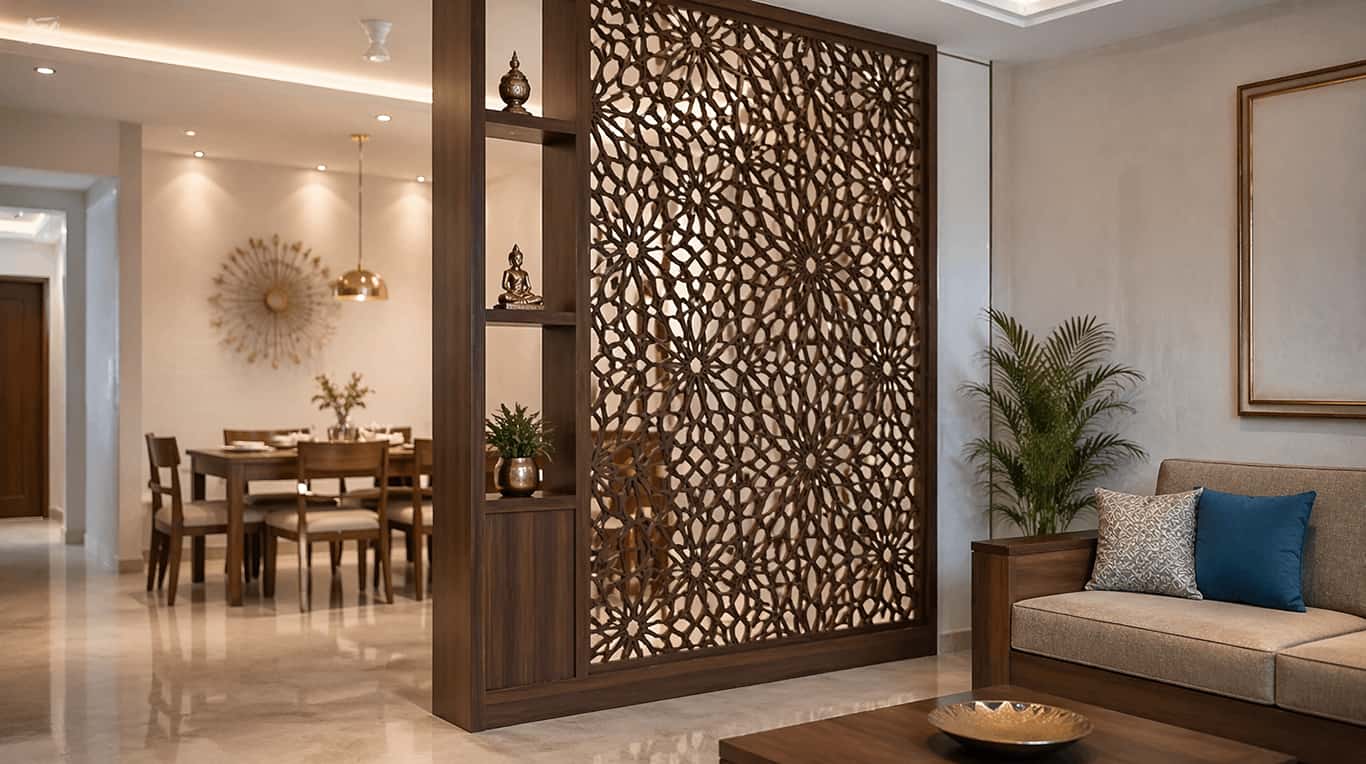
Open spaces need smart separation without blocking natural light. Our CNC wood partition design solutions use both solid wood and MDF to create stylish, functional dividers. MDF is perfect for intricate painted jali patterns, while solid wood partitions offer unmatched durability for high traffic commercial showrooms.
Modern homes and offices in Indore frequently utilize open floor plans. To divide these spaces elegantly without building solid walls, interior designers rely heavily on custom partitions. We specialize in intricate CNC cut wooden partition designs that are customized to your specific interior theme.
When clients ask for a white, high gloss jali partition for a modern living room, we immediately recommend MDF. MDF is ideal for decorative jali work due to its smooth surface and complete design flexibility. Our advanced MDF CNC cutting equipment ensures sharp edges and smooth curves, allowing us to manufacture complex arabesque, geometric, and floral patterns. The finished MDF jali panels are supplied ready for painting or laminating.
However, if the partition is for a high end hospitality interior, a busy office reception area, or a client who simply loves natural timber, we switch to solid wood. Using our CNC 3D wood carving machines, we can deliver depth, symmetry, and consistency on solid wood partitions that manual carving simply cannot match. For clients seeking advanced detailing, we also combine traditional wood projects with precise CNC laser cutting technology where fine detail demands it.
Spiritual spaces: Mandir and Ganesh Panels
Religious spaces require absolute precision and respect. We create custom MDF laser cutting Ganesh CNC designs and mandir back panels with devotional accuracy. MDF is the standard choice for these intricate religious geometries because it holds very fine detail without splintering.
A residential prayer corner or mandir is often the most detailed and visually complex area of a home interior. The backdrop usually requires highly intricate religious motifs, bells, lotus patterns, or 3D deity carvings.
For large feature walls and 3D relief carvings in temples, we often use solid wood or HDHMR to produce sculptural surfaces that look incredibly rich. The depth and sharpness of CNC technology allow us to carve massive Ganesh panels with a level of symmetry that takes human hands months to achieve.
For more delicate, lightweight mandir applications, we provide precision laser cutting MDF services. Laser cutting an MDF sheet allows us to cut extremely thin lines and complex geometric patterns that a spinning router bit might accidentally snap. These lightweight laser cut MDF panels transform plain mandir backgrounds into layered, textured highlights. Our clients across Indore trust our craftsmanship to deliver these spiritual panels with perfectly clean finishing.
Solid wood vs MDF for wardrobe design
When choosing between solid wood vs MDF for wardrobe doors, MDF is often the better option for modern designs. It remains perfectly flat for tall sliding shutters and takes glossy finishes beautifully. Solid wood is much better for the internal wardrobe frame due to its superior screw holding capacity.
Wardrobes dominate the visual space in any bedroom. The material you choose for the large front shutters dictates the entire look of the room. Modern interior design heavily favors flat, sleek, and minimalist wardrobe doors without heavy traditional paneling.
For tall, floor to ceiling wardrobe shutters, MDF is fantastic. Solid wood panels over six feet tall have a very high tendency to warp or bow over time due to their natural movement. MDF stays dead flat. Furthermore, if you want your wardrobe to have a flawless acrylic or high gloss PU paint finish, MDF is the only logical substrate. It provides the smooth base needed for those highly reflective modern finishes. At Eish CNC Designs, we regularly manufacture wardrobe panels and custom cabinet shutters with geometric perforations, ensuring every piece matches perfectly across an entire room fitout.
However, the internal structural frame of the wardrobe requires immense strength. The heavy duty hinges carry a lot of weight. Using standard MDF for the vertical side panels where the hinges attach is a mistake. The repetitive stress of opening and closing the heavy doors will eventually pull the screws right out of the MDF. The best approach is a smart hybrid one. Use a strong material like solid wood or high grade plywood for the internal carcass to hold the screws tightly, and use MDF for the large decorative front doors.
MDF vs solid wood for bed frames
Comparing MDF vs solid wood for bed frames reveals a clear and undeniable winner. Solid wood is the absolute best choice for bed construction because of its structural integrity and load bearing capacity. MDF is suitable only for decorative headboards, not for the load bearing side rails or legs.
A bed frame takes a massive amount of physical abuse over its lifetime. It carries the dead weight of a heavy mattress and the dynamic weight of multiple people. It gets bumped by vacuum cleaners and shifted across the room during deep cleaning.
Solid wood is the traditional and vastly superior choice for beds. The long side rails of a bed need to be incredibly stiff and hold heavy metal bolts securely. Solid timber handles this extreme stress easily. A well built Teak or Sheesham bed will remain sturdy and perfectly silent for decades. The joints can be tightened if needed, and the frame will not crack under normal use.
Using standard MDF for a structural bed frame is highly risky. The material simply does not have the tensile strength to span the length of a bed without eventually sagging. The bolt holes where the side rails meet the headboard will eventually loosen and strip out, leading to a squeaky, wobbly, and unstable bed.
The only place MDF truly belongs in bed construction is the headboard itself. If you want an intricate CNC wood carving bed design for a luxury bedroom, an MDF or HDHMR backing panel works perfectly. We regularly carve artistic wood CNC art and wall panels for master bedrooms. MDF does not carry any structural weight, and its flawlessly smooth surface is ideal for deep routing or adhering upholstery fabric.
Engineered wood vs solid wood in Indian climates
The battle of engineered wood vs solid wood plays out very differently across India. Solid wood handles seasonal humidity well but can suffer from termite attacks if untreated. Standard MDF is highly vulnerable to moisture swelling but is generally less attractive to termites due to its resin content.
India has an incredibly diverse and often harsh climate. A piece of furniture that survives nicely in a dry, air conditioned office might fail completely in a humid, naturally ventilated home. You absolutely must consider your local environment when choosing interior materials.
During the Indian monsoon, the air becomes completely saturated with moisture. Solid wood absorbs this ambient humidity and physically swells. This is why wooden doors often stick in their frames during July and August. A good carpenter leaves expansion gaps in solid wood furniture to accommodate this natural seasonal movement. Engineered boards like MDF do not expand and contract with seasonal humidity changes in the same way. They are highly dimensionally stable. (For extremely damp environments like bathrooms, consider comparing MDF vs HDHMR instead).
However, direct water contact is a completely different story. If a solid wood table leg gets wet while you are mopping the floor, it will dry out later with no real damage. If a standard MDF table leg gets wet, it will soak up the water like a dry sponge and bloat out of shape permanently. You must seal every single exposed edge of an MDF board with high quality edge banding to prevent ambient moisture from destroying the core.
Termites are another huge concern in Indian homes. Natural softwoods are a feast for termites. High quality Indian Teak has natural oils that naturally repel pests, but it is very expensive. MDF offers some slight resistance simply because the heavy glue and toxic resin content is hard for pests to digest, but it is definitely not completely termite proof. We always recommend proper pest control treatments regardless of your final material choice.
Evaluating MDF furniture pros and cons
The main MDF furniture pros and cons center around finish quality and durability. Pros include a perfectly smooth surface, zero natural defects, highly affordable pricing, and dimensional stability. Cons include heavy weight, poor screw holding ability, and severe vulnerability to water damage if unsealed.
Let us break down exactly what you get when you decide to buy MDF furniture.
The biggest advantage is the finish quality. You will never find a hidden knot, a void, or a split in a piece of MDF. This absolute uniformity allows our CNC operators to mass produce furniture components with perfect consistency. It is the perfect substrate material for applying thin veneers, decorative laminates, and spray paints. Because it does not warp with temperature changes, it is excellent for large flat decorative wall panels and slatted linear designs. It is also highly affordable, making stylish modern furniture accessible on a tight budget.
The disadvantages are equally significant. MDF is exceptionally heavy. Moving large MDF furniture is difficult and puts a lot of stress on the joints. If the factory applied edge banding peels off, the raw exposed core is totally vulnerable to ambient humidity and will begin to degrade. You cannot repair MDF easily. If you scratch the surface deeply or chip a sharp corner, you cannot simply sand it down like natural timber. You have to fill it with automotive putty, sand it flush, and repaint the entire panel. It is a brilliant material for decorative use, but it requires careful handling.
Exploring solid wood furniture advantages
Solid wood furniture advantages include incredible longevity, high structural strength, the ability to be repaired and refinished, and a timeless natural beauty. Every single piece is unique. However, it requires seasonal maintenance and carries a significant premium price tag.
There is a very good reason antique furniture is made of solid wood. It survives. The primary advantage of natural timber is its structural integrity. It can literally take a beating. A solid wood dining chair can endure years of being dragged heavily across a floor and tipped backwards without the joints failing.
The aesthetic appeal is undeniable. The natural grain patterns add a warmth and character to a room that cold engineered boards simply cannot replicate. You can stain it to match different interior color schemes while keeping the beautiful natural texture completely visible. At Eish CNC Designs, our clients love the organic feel of our solid carved main doors and artistic wooden installations.
The greatest hidden advantage is repairability. A solid wood coffee table covered in water rings, deep scratches, and dents can be restored to pristine showroom condition by a skilled polisher in a single afternoon. This gives solid wood furniture a lifecycle that spans generations, rather than just a few years.
The drawbacks are mostly related to cost and maintenance. Good quality seasoned timber is expensive and becoming harder to source sustainably. You also have to protect it from extreme temperature fluctuations and apply fresh polish every few years to keep the wood nourished and prevent fine surface cracking.
Pricing reality: MDF board price vs solid wood cost
When looking at project costs, the MDF board price is vastly lower than solid timber. Standard MDF is an affordable, mass produced sheet material. Solid wood pricing varies wildly based on the species, with premium Indian hardwoods costing several times more than an equivalent volume of MDF.
Budget often drives the final decision in major interior projects. The price difference between these materials is stark.
MDF is sold in standardized sheets, typically 8x4 feet, in various thicknesses like 12mm or 18mm. The pricing is predictable and generally very affordable. You can buy a standard 18mm sheet of interior grade MDF for a fraction of the cost of plywood or natural wood.
Solid wood is sold by cubic feet (cft) in timber yards. The price depends entirely on the tree species and the quality of the cut. Softwoods like Pine are relatively cheap but dent very easily. Premium hardwoods like CP Teak or imported Walnut are incredibly expensive. A solid wood custom installation will easily cost three to four times more than an MDF panel of the exact same dimensions.
When you factor in skilled labor, the gap widens further. Working with solid wood requires highly specialized traditional carpentry skills to joint, plane, and finish the timber properly. CNC routing MDF is much faster and requires less manual jointing skill, which significantly lowers the overall fabrication cost of your commercial projects and store display units.
MDF vs plywood vs solid wood: The quick guide
In the MDF vs plywood vs solid wood debate, use solid wood for heavy structural furniture, plywood for modular kitchen carcasses and damp areas, and MDF for decorative panelling, false ceiling jali, and flawlessly painted shutters.
It is impossible to discuss interior materials without mentioning plywood. Plywood sits right in the middle of this debate. It is made by gluing thin layers of real wood veneer together in alternating directions.
Plywood offers a truly great balance. It is much stronger than MDF and holds screws very well. (If you are debating between these two engineered boards, read our detailed guide on MDF vs Plywood.) It is significantly cheaper than premium solid wood. High quality boiling waterproof (BWP) plywood handles moisture excellently, making it the absolute default choice for modular kitchen cabinets across Indore.
At Eish CNC Designs, we offer precision plywood CNC and laser cutting services for furniture, décor, and custom utility items. We guide clients on selecting the best plywood for laser cutting to ensure clean edges and long-lasting results. We regularly process laser cutting 3mm plywood and laser cut 5mm plywood for custom boxes and intricate components.
Your material strategy should combine all three. Use solid wood for the heavy bed frame and main doors. Use BWP plywood for the kitchen cabinets and the internal wardrobe carcasses. Use MDF for the living room wall panelling, decorative jali dividers, and the sleek painted wardrobe doors. Mixing materials strategically based on their unique strengths is the secret to a durable and beautiful home interior.
CNC Carving on Wood and MDF at Eish CNC Designs
When performing CNC cutting, standard MDF provides clean, sharp details with zero grain tear out, making it perfect for complex laser cut ceiling patterns. Solid wood machines beautifully but requires expert calculation of grain direction and feed rates to prevent splintering during deep 3D carving.
Our workshop is equipped with modern CNC machine wood design systems that allow intricate cutting, carving, and shaping of wood, plywood, and MDF with millimetre accuracy. The way these materials behave under a spinning cutter head is fascinating.
When we cut a delicate 2D MDF jali panel, the machine glides through the material. Because there is no grain structure at all, the router bit cuts perfectly cleanly in every single direction. The edges come out sharp and require minimal sanding. We handle high speed production for bulk orders, ensuring consistent depth across all designs. Beyond cutting, we also deliver creative MDF laser design and engraving solutions, including personalized panels using laser engraved pine MDF.
Solid wood is a different beast entirely. It machines beautifully, but it demands respect. Our experienced professionals understand the natural grain direction. If the router bit cuts against the grain too aggressively, it can tear out chunks of the wood and instantly ruin an expensive piece of timber. We have to adjust our feed rates and spindle speeds carefully based on the specific hardness of the wood species we are carving.
When done correctly, a CNC carved solid wood panel is a true work of art. The way the natural grain intersects with the carved 3D geometry creates a visual depth that flat MDF simply cannot achieve. It is highly premium work, resulting in clean and smooth carving wood CNC finishes that our residential and commercial clients absolutely love.
At a Glance: MDF vs Wood Comparison Table
| Feature | Solid Wood | MDF (Medium Density Fibreboard) |
|---|---|---|
| Material Structure | Natural timber with wood grain. | Engineered fine wood fibres and resin. |
| Surface Finish | Textured, porous, shows natural grain. | Perfectly smooth, zero grain, uniform. |
| Structural Strength | Extremely high. Carries heavy loads easily. | Low. Sags under heavy weight. |
| Moisture Handling | Expands and contracts but recovers when dry. | Swells instantly and permanently if unsealed. |
| Screw Holding | Excellent. Can be re-screwed multiple times. | Poor. Threads strip out easily. |
| Repairability | High. Can be sanded and refinished repeatedly. | Very Low. Cannot be easily sanded or patched. |
| Best Used For | Beds, dining tables, chairs, main doors. | Wall panelling, painted shutters, 3D CNC reliefs. |
| Cost | Expensive (varies by wood species). | Highly affordable and budget friendly. |
Final Verdict: Which should you choose?
Choosing between these materials is not about finding which one is universally better. It is entirely about matching the right material to the right job.
If you are building structural furniture that needs to support heavy weight or endure daily physical wear, you must invest in solid wood. Your bed, your dining chairs, and your main entrance door fall squarely into this category. The initial cost is high, but the longevity guarantees you will not be replacing them in five years.
If you are focusing heavily on aesthetics, particularly modern designs with flat surfaces and high gloss colors, MDF is your best friend. It provides the flawless canvas required for contemporary interior styling. Use it for decorative wall panels, TV unit backing, and bedroom wardrobe doors. It will save you money and deliver a visually stunning result, provided you keep it far away from water.
Are you planning a custom interior project in Indore and need professional fabrication support? We specialize in transforming both MDF and solid wood into stunning architectural elements. Whether you need CNC wood carving near me searches answered or detailed MDF sheet CNC cutting, we have the advanced machines and the local Indore support to deliver faster. Get a free design consultation today, and we will help you select the perfect material for your custom jali partitions, 3D carved doors, and interior panelling needs. Contact Us to discuss your next project!
Frequently Asked Questions
Which is better MDF or wood?
It depends entirely on your project. Solid wood is significantly better for structural furniture like main doors and beds due to its extreme durability. MDF is better for painted finishes, decorative jali partitions, and non-load-bearing ceiling panels because it offers a perfectly smooth, knot-free surface.
Is MDF cheaper than wood?
Yes, the MDF board price is vastly lower than natural solid wood. Depending on the specific species of wood, MDF can cost 50% to 80% less, making it a highly budget-friendly option for decorative interior projects and CNC laser cutting.
Does MDF last as long as wood?
No, solid wood will generally outlast MDF by decades. Natural wood can be sanded down and refinished multiple times over a lifetime. MDF cannot be repaired easily if the edges swell from moisture or if the core gets damaged.
Is MDF wood good for furniture?
MDF is excellent for certain types of modern furniture. It works very well for wardrobe doors, TV units, and decorative panels. It is strongly not recommended for heavy load-bearing furniture or wet areas like kitchen sink cabinets.