
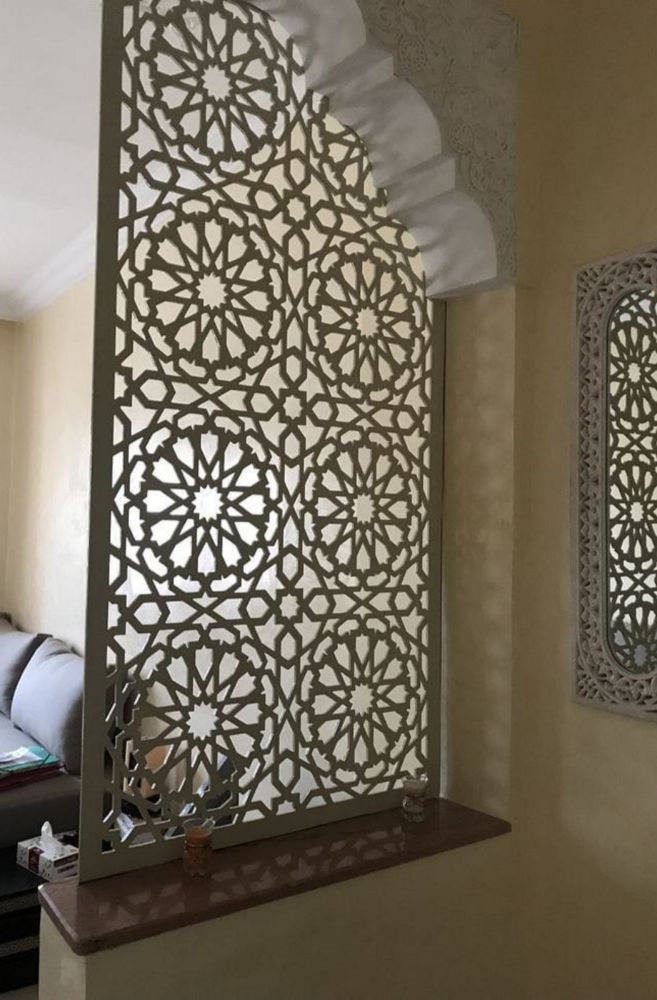
You walk into a home decor showroom in Indore and something catches your eye. It is a glowing panel on the wall, casting warm amber light through what looks like impossibly delicate cutwork. Floral motifs. Sharp lines. A halo of light behind each tiny gap. Your first instinct is to reach out and touch it. The surface is cool, smooth, glass-like. But it is not glass. It is acrylic.
The question "What Is Acrylic Sheet Used For" gets searched thousands of times a month in India because this material has quietly moved from industrial factories into living rooms, temples, offices, and retail stores. Architects specify it. Interior designers love it. Business owners rely on it for their shop signs. And homeowners are now discovering that a well-designed acrylic panel can transform an ordinary room into something that stops visitors mid-sentence.
At Eish CNC Designs, we process acrylic sheets on our laser machines every single day. We cut mandir panels, fabricate LED sign boards, make custom nameplates, and build decorative partitions for residential and commercial clients across Indore. This guide covers every major acrylic application in honest, practical detail, including the thickness choices, types of acrylic that work best, and the exact uses where this material beats glass, MDF, and metal every time.
What Is Acrylic Sheet, Exactly?
Acrylic sheet is a transparent thermoplastic material made from polymethyl methacrylate (PMMA). It is roughly half the weight of glass, significantly stronger against impact, and can be laser cut to produce polished edges without any secondary finishing. It is sold under brand names like Plexiglas, Perspex, and Lucite.
The simplest way to explain acrylic is this: it is a plastic that behaves like glass but is far easier to work with. Glass transmits about 91% of visible light. Acrylic sheet transmits 92%. For all practical purposes, they look identical when you hold them up to a window. The critical difference is what happens when you try to cut them into complex shapes.
Glass needs a diamond wheel cutter and skilled hands to make straight lines. Curved cuts require specialist equipment. Intricate patterns are essentially impossible without very expensive water-jet or sandblasting equipment. Acrylic, on the other hand, accepts a laser beam the way a hot knife accepts butter. The CO2 laser traces your vector artwork precisely, vaporising the material along the path and leaving a smooth, polished edge that looks like it was finished by hand. It is not. The machine does it automatically.
This is the fundamental reason acrylic has become the dominant material for decorative laser cutting across India.
Acrylic Mandir Panels and Pooja Room Designs
Acrylic is one of the most popular materials for laser cut mandir panels because a backlit acrylic sheet with devotional motifs creates a divine, glowing ambience that no other material can replicate. The laser polishes the cut edges as it works, so each tiny curve in a floral or Om pattern holds a perfect, luminous edge.
A traditional wooden mandir has warmth and heritage. But when a client comes to us asking for a back panel for their modern apartment pooja room, wood has one limitation: it blocks light entirely. If you want a backlit effect, you need a material that allows light to pass through it.
That is where acrylic mandir design panels have become genuinely popular. The process is straightforward. We start with a 4mm or 6mm clear or frosted cast acrylic sheet. Your chosen devotional pattern, whether it is an intricate lotus mandala, an Om symbol surrounded by floral borders, or a scene depicting your family deity, is fed into our laser cutting software. The machine traces every line of that artwork to a precision of fractions of a millimetre.
When the cut panel is mounted on a wall with warm LED strips behind it, the light pushes through the cut openings and the semi-transparent body of the sheet simultaneously. The result is a soft, golden glow that feels genuinely sacred. Many clients tell us their family's daily prayer time feels more immersive with this kind of lighting than with a standard tube light overhead.
You can explore our full range of mandir panel options on our acrylic mandir panels page. If you are also considering wood-finished mandirs, our MDF jali design for mandir service gives you a warm, natural alternative.
LED Sign Boards and Business Signage
Acrylic LED sign boards are the most common commercial application for this material in India. A shop name or logo is laser cut or engraved into a backlit acrylic panel, creating a glowing sign that is visible day and night. Acrylic sign boards are more durable than flex banners and far cheaper than metal illuminated signs.
Walk down any commercial street in Indore today. Count the shops. Now count how many have a glowing sign. Most of them are using acrylic in some form. The material has completely replaced the old painted tin board for retail signage because the cost-to-impact ratio is simply unmatched.
Here is how a standard LED acrylic sign board is made. A base sheet of 6mm white or coloured acrylic is cut to the required shape. The shop name and logo are either laser engraved into the surface (which creates a frosted contrast against the clear or coloured background) or the letters are cut as separate acrylic elements and bonded on top. LED strip lights are mounted inside an aluminium box frame behind the sheet. When switched on, the light travels through the sheet and the engraved areas glow brightly against the darker background.
The business applications go beyond shop fronts. We fabricate acrylic sign boards for reception desks, hospital ward indicators, hotel room numbers, restaurant menus, and directional signage inside office buildings. Each application uses a slightly different combination of acrylic thickness, colour, and LED colour temperature to achieve the right visual effect.
Our acrylic laser cutting service covers all of these commercial signage requirements with quick turnaround and competitive pricing in Indore.
Decorative Acrylic Partitions and Room Dividers
Decorative acrylic partition screens are used in modern homes, restaurants, and offices to divide spaces without blocking light. Because acrylic is transparent or translucent, a laser cut partition screen adds visual interest and privacy while keeping the room feel open and airy.
The demand for room dividers that do not make a space feel smaller has grown significantly with open-plan apartment design. A solid wall solves the privacy problem but creates a visual barrier that shrinks the room. A glass partition is clean but bland and expensive. An acrylic laser cut partition screen does something neither of those can: it creates a decorative focal point that defines the zone while still allowing light to flow freely through the pattern.
Popular applications we see regularly include:
- Living room and dining area dividers with geometric or floral laser-cut patterns
- Restaurant seating partitions that create intimate zones without closed-off booths
- Office reception area screens with a company logo or brand pattern
- Bedroom headboard panels with backlit acrylic creating a soft ambient wall
- Staircase balustrade infill panels in modern villas
For thicker, structural partition applications we typically use 8mm or 10mm cast acrylic. For purely decorative flat screens that are mounted in a frame, 4mm or 6mm works well. You can see the range of interior panel designs we produce on our acrylic interior panels page.
Acrylic Nameplates for Homes and Offices
Laser cut acrylic nameplates are a clean, professional alternative to metal or painted boards for home door plates and office desk nameplates. Acrylic accepts laser engraving with exceptional precision, allowing for small text, logos, and decorative borders that look premium at a fraction of the cost of brass or stainless steel.
There is something satisfying about a nameplate that looks expensive without actually being expensive. Acrylic hits that sweet spot consistently. A 3mm or 4mm sheet of black acrylic with gold or white laser-engraved text looks, at first glance, like anodised metal. The clarity of the engraving is clean enough that even small font sizes are perfectly readable.
We produce acrylic nameplates for several different use cases. Home entrance plates with the family name and flat number in both English and Hindi script are very popular. Office desk nameplates with name, designation, and company logo are standard for corporate clients. Hospital wards and clinic room plates where colour coding is important are another regular requirement.
One advantage of acrylic over metal for office nameplates is how easy it is to update. If an employee changes designation, replacing an acrylic nameplate costs a fraction of what a metal engraved plate would. For bulk office fitouts, this practical cost saving matters.
Retail Display Stands and Point-of-Sale Units
Acrylic is the standard material for retail display stands, product trays, brochure holders, and point-of-sale units because it is transparent, lightweight, and easy to clean. Jewellery display cases, cosmetic display trays, and watch holders are almost universally made from clear acrylic sheet.
Walk into any organised retail store in India and look at the product display units. The clear trays holding the cosmetics. The tiered stands showing the sunglasses. The small rectangular holders for business cards near the cash counter. The vast majority of these are acrylic, specifically because transparency allows the product to be the focus rather than the display itself.
For retail applications, 2mm to 4mm clear extruded acrylic is commonly used since display stands do not need to carry heavy loads. Thicker 6mm sheets are used for structural units like jewellery display cases where the acrylic panels form the walls and lid of a box unit. The material can be heat-bent using a strip heater, allowing flat sheets to be formed into the three-dimensional box shapes needed for display cases without any cutting joints.
Acrylic Sheet Thickness Guide: Which Thickness for Which Use?
Acrylic sheet thickness should be matched to its application. Thin sheets from 2mm to 4mm suit decorative panels, nameplates, and display trays. Mid-range sheets of 6mm to 8mm are ideal for sign boards, mandir panels, and partition screens. Sheets of 10mm and above are used for structural purposes like aquarium walls, protective barriers, and machine guards.
This is one of the most common questions we get from clients: what thickness should I order? The answer depends entirely on what you are making. Here is a practical guide:
| Thickness | Best Application | Notes |
|---|---|---|
| 2mm to 3mm | Nameplates, display trays, decorative inserts | Flexible; not suitable for freestanding use |
| 4mm to 5mm | Mandir panels, framed wall art, acrylic signs | Rigid enough when framed; most popular for decorative work |
| 6mm | LED sign boards, partition screens, reception panels | Excellent structural rigidity for standard applications |
| 8mm to 10mm | Structural partitions, machine guards, heavy display cases | Heavy; professional installation recommended |
| 12mm and above | Aquariums, protective barriers, industrial uses | Speciality application; high cost |
Cast Acrylic vs Extruded Acrylic: What Is the Real Difference?
Cast acrylic is made by pouring liquid PMMA into a glass mould and curing it slowly. This produces a harder, optically superior sheet with consistent thickness and a polished laser-cut edge. Extruded acrylic is cheaper and produced faster but is softer, slightly less clear, and produces a less refined laser-cut edge. For decorative and signage work, cast acrylic is always the better choice.
If you have ever ordered an acrylic sheet and been confused about why two apparently similar sheets behave so differently under the laser, the answer is almost always that one is cast and the other is extruded.
Extruded acrylic costs about 20% to 30% less than cast acrylic of the same thickness. For bulk applications where edge quality is not critical, that saving matters. But for a laser cut mandir panel or a premium acrylic nameplate, the difference in edge quality between cast and extruded is immediately visible. Cast acrylic edges come out of the laser looking flame-polished. Extruded acrylic edges are slightly milky and require additional polishing to match the same finish.
Our laser cutting service uses cast acrylic for all decorative and signage projects to ensure the finish is consistent and premium from the first cut to the last.
Why Architects and Interior Designers Specify Acrylic
Architects specify acrylic for interior projects because it combines optical clarity with design flexibility that no other affordable material matches. It can be laser cut, CNC routed, heat bent, bonded, screen printed, and spray painted, making it the most versatile transparent material available for contemporary Indian interior design.
Talk to any interior designer working on high-end residential projects in Indore and you will likely hear about acrylic panels being specified for the pooja room, the feature wall behind the bed, or the reception desk panel. The material has earned its place in professional specification for several concrete reasons.
First, it works with lighting in ways that other materials do not. An acrylic panel does not just sit there looking decorative in the daytime. When the room lights change at night, the panel transforms. Colours shift. The glow through laser-cut openings creates shadow patterns on adjacent walls. The entire mood of the room changes based on the LED colour you choose. No paint, no wallpaper, no wooden panel can do this.
Second, acrylic is genuinely low maintenance in the Indian climate. It does not rot, rust, or warp in humidity the way MDF and wood can. It does not develop the white mineral deposits that plague glass in hard water areas. A clean acrylic panel looks the same five years after installation as it did on day one, assuming it is cleaned correctly.
If you want to see how acrylic panels are being used in current interior projects we have completed, our project gallery has recent examples from residential and commercial installations across Indore.
How Acrylic Sheet Compares to Other Materials
Compared to glass, acrylic is lighter and safer. Compared to MDF, acrylic transmits light. Compared to metal, acrylic is cheaper and easier to fabricate for decorative work. For applications requiring optical clarity combined with intricate laser cutting, acrylic has no practical competitor at the same price point.
Clients often ask us to compare acrylic to the alternatives before committing to a project. Here is an honest breakdown.
Acrylic vs glass: Glass wins on scratch resistance. Acrylic wins on weight (50% lighter), safety (does not shatter dangerously), cost for complex shapes, and the ability to be laser cut into intricate patterns. For most interior decorative applications, acrylic is the more practical choice.
Acrylic vs MDF: They are used for different things, but there is overlap in partition and panel applications. MDF is opaque, takes paint well, and is excellent for CNC-routed jali panels where you want a wood aesthetic. If you want light to pass through the panel or if you need optical clarity, acrylic is the only option. You can read our detailed comparison in the MDF vs HDHMR guide to understand when MDF makes more sense for your project.
Acrylic vs metal: For structural applications, metal wins. For decorative laser cutting and signage, acrylic is significantly cheaper to cut and fabricate. Our CNC metal cutting service handles projects where structural strength or a premium metal finish is the primary requirement.
How to Get Acrylic Laser Cutting Done in Indore
To get acrylic laser cutting done in Indore, share your artwork in a vector format such as AI, CDR, or DXF with a laser cutting service. The team will confirm acrylic type, thickness, and machine time cost before production begins. Most standard projects are delivered within two to three working days.
The process at our workshop is straightforward. If you have a design ready in Adobe Illustrator, CorelDRAW, or AutoCAD, you can simply WhatsApp us the file. We check it for cutting compatibility, confirm the acrylic sheet specifications, and send you a quotation within a few hours.
If you do not have a design file, our in-house team can help you develop one. We work with homeowners who bring reference images, architects who need standard geometric patterns, and business owners who want their logo adapted for acrylic signage.
For clients working on larger interior projects involving multiple materials, we also offer CNC wood cutting and MDF CNC cutting services from the same facility, which makes it easier to co-ordinate multi-material fitouts without dealing with multiple vendors.
Our complete guide to CNC laser cutting design in Indore is a good read if you are exploring what is possible before making a decision on your project material and design style.
Conclusion
So, what is acrylic sheet used for? The answer is: almost everything that needs to be transparent, precisely cut, and visually refined. Mandir panels, LED sign boards, decorative partitions, nameplates, retail display stands, machine guards, aquariums, furniture panels, backlit wall art, and commercial signage. Its combination of optical clarity, light weight, weather resistance, and laser-cutting compatibility makes it the dominant material for transparent decorative applications in contemporary Indian interiors and retail environments.
If you need something that looks refined, transmits or plays with light, and holds a precise laser-cut edge, acrylic is where you start. Ready to begin? Share your reference images or vector files with our team and we will take it from there. Contact us today to get started.