
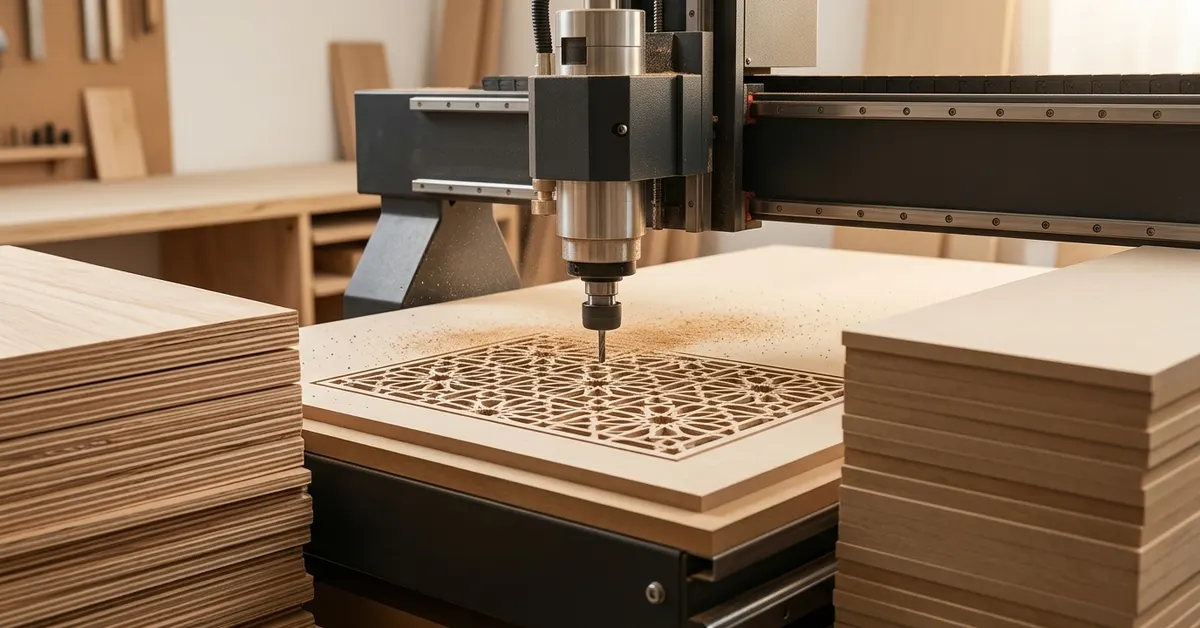
Every month, a carpenter or an interior designer walks into our workshop with the same worry. The drawings are ready, the client has approved the design, and then comes the awkward question: should the job go on HDHMR or on plywood? Pick wrong and you pay for it later. Edges chip during cutting, paint cracks over a visible core gap, or a heavy wardrobe shelf starts to sag in two years. If you are fabricating storage units or beds, our CNC cutting for furniture in Indore team sees this exact decision on the shop floor every single week.
So here is the honest answer to HDHMR vs plywood. Neither board wins everywhere. HDHMR is the better choice for CNC carving, jali screens and painted shutters. Plywood is the better choice for frames and shelves that carry weight. Having routed thousands of sheets through our HDHMR CNC cutting services in Indore, we break down exactly how both materials behave under real workshop conditions.
You will also find a comparison table, a price range, a project by project recommendation and straight answers to the questions people type into Google every day.
HDHMR vs Plywood: Which Material Is Better for CNC Cutting and Furniture?
HDHMR is better for CNC cutting, decorative carving and painted finishes. Plywood is better for load bearing furniture frames. Choose HDHMR when surface detail matters most, and choose plywood when structural strength matters most.
Selecting between High Density High Moisture Resistance board and Boiling Water Resistant plywood decides how long your furniture lasts and how precisely it can be machined. The two boards look similar on a dealer's rack, but they are built in completely different ways.
HDHMR is made by compressing wood fibres with specialised water resistant resins under high temperature. The result is a dense and uniform internal structure with no hollow voids. That even composition is why HDHMR is the preferred medium for intricate 2D jali screens, 3D relief carving and modular cabinet doors on high speed CNC routers.
Plywood is built from thin timber veneers laid in alternating grain directions and bonded under hydraulic pressure. This cross lamination gives it excellent tensile strength against bending. That makes plywood the sensible pick for heavy wardrobe carcasses, bed frames and structural joinery. But the same layered build creates trouble when a router bit passes through at speed.
What Is HDHMR Board?
HDHMR stands for High Density High Moisture Resistance board. It is an engineered wood panel made from compressed wood fibres and water resistant resin, with a density usually between 800 and 900 kg per cubic metre, and a smooth, void free core.
If you have searched for the HDHMR board price or the HDHMR sheet price, you have probably noticed that dealers quote very different rates for the same thickness. The gap usually comes from density. A genuine board sits near 850 kg per cubic metre and weighs noticeably more than a cheap lookalike. When you lift a 18mm sheet, it should feel heavy and solid, not light and spongy.
Because HDHMR has no grain, it behaves the same in every direction. A router bit sees one consistent material from edge to edge. That is also why the surface takes primer, PU paint and laminate so evenly. For a deeper look at how it compares with a cheaper fibre board, read our guide on MDF vs HDHMR.
What Is Plywood?
Plywood is a layered wood panel made by gluing thin veneers together with each layer turned ninety degrees from the one below. Common furniture grades in India are BWR, BWP (also called marine grade) and commercial plywood.
Each veneer layer adds strength in a different direction, which is why a plywood sheet resists bending and holds screws along the edge better than most boards. The glue decides the grade. Commercial plywood uses urea glue and suits dry interiors only. BWR plywood uses a boiling water resistant glue and is the standard for kitchens and wardrobes. BWP or marine plywood uses a phenolic glue and survives wet conditions much better.
Face veneer quality matters too. Premium Gurjan or birch plywood has fewer core gaps and a tighter layer structure than budget sheets, and that difference shows up quickly during CNC work.
CNC Cutting Performance: HDHMR vs Plywood
HDHMR cuts cleaner. Router bits pass through its uniform core without tearing, so edges come off the machine crisp and ready for primer. Plywood can chip along the veneer layers and may reveal core gaps that need putty filling.
Here is where the difference becomes visible. When a multi axis router bit carves through HDHMR, the walls of a jali slot come out smooth and sharp. We can run a 3mm slot or a fine floral pattern at normal feed rates, and the edge needs only a light hand sanding before polyurethane paint or lamination.
Plywood behaves differently. A bit crossing alternating grain directions can lift fibres on the top veneer, splinter at the exit side or expose a hollow pocket inside the core. On a plain straight cut, you may never notice. On a detailed pattern with tight curves, you will. Those flaws need manual putty filling and heavier edge banding before the part looks finished.
Our technical testing at the Indore workshop confirms this pattern. HDHMR eliminates edge fraying during high speed spindle passes. Premium Gurjan or birch plywood still performs well, but it excels when load bearing integrity outweighs decorative surface carving.
HDHMR vs Plywood Comparison Table
Here is a side by side view across the factors that matter for CNC projects and furniture in India:
| Factor | HDHMR | Plywood (BWR or BWP) | Better Choice |
|---|---|---|---|
| Edge quality after CNC cutting | Crisp and clean, minimal sanding | Possible chipping and core gaps | HDHMR |
| 3D relief carving | Excellent, consistent depth | Limited, layers can tear | HDHMR |
| Paint and PU finish | Smooth, takes paint evenly | Needs putty, grain may show | HDHMR |
| Bending and load strength | Good for panels, weaker as a long span | Excellent tensile strength | Plywood |
| Screw holding on edges | Good | Very good | Plywood |
| Moisture resistance | High, not waterproof | BWR good, BWP very high | BWP plywood |
| Weight per sheet | Heavier | Lighter | Plywood |
| Surface consistency | Uniform, no voids | Varies by brand and grade | HDHMR |
| Cost for finished decorative work | Lower finishing labour | Higher putty and sanding labour | HDHMR |
Strength and Durability: Where Plywood Wins
Plywood is stronger in bending and carries heavy loads better than HDHMR. For bed frames, long wardrobe shelves and structural joinery, plywood remains the safer choice.
Let's be real. HDHMR is a great board, but it is not magic. Because it is made from fibres and not from continuous wood veneers, it can sag under a heavy load spread over a long span. A 5 feet shelf loaded with books will bend over time on a thin HDHMR sheet. The same shelf in 18mm BWR plywood will hold its line for years.
Plywood also handles nails and screws near the edge with less risk of splitting. Hinges, drawer channels and bed joinery all benefit from that. If you are building a heavy storage bed or a full height wardrobe carcass, we recommend plywood for the frame and HDHMR for the visible shutters.
Moisture Resistance: HDHMR vs BWR and Marine Plywood
HDHMR resists humidity well but is not waterproof. BWR plywood handles damp conditions, and BWP marine plywood performs best in wet areas such as under sink units and bathroom cabinets.
Moisture is the biggest reason people consider these boards over standard MDF. HDHMR is made with water resistant resin, so it tolerates kitchen humidity, steam and the occasional splash without swelling. Still, if water sits on a cut edge for days, any fibre board will eventually take it in. Edge sealing during fabrication makes a real difference.
BWR plywood is good for most modular kitchen carcasses. For the sink base unit and bathroom vanities, BWP plywood or a fully sealed HDHMR board is the safer route. Indore's monsoon months can be rough on poorly sealed edges, so always ask your fabricator how the cut edges are protected.
HDHMR vs Plywood Price in India
HDHMR usually costs about the same as good quality BWR plywood and clearly less than marine grade plywood. The real saving comes from finishing, because HDHMR needs less putty and sanding before paint.
Sheet prices change by brand, thickness, grade and city, so any number printed in a blog goes out of date quickly. Use the pattern below as a guide and confirm with your dealer.
Don't compare sheet rates alone. A plywood panel that needs two rounds of putty and heavy sanding costs more in labour than an HDHMR panel that goes straight to primer. For a full breakdown of machining charges, see our CNC cutting price in Indore guide.
Which Is Better for a Modular Kitchen?
Use HDHMR for modular kitchen shutters and cabinet boxes in most homes. Use BWP plywood for the sink base and any area that can see direct water.
Kitchens are tough on boards. Steam, grease, daily cleaning and constant door movement all test the material. HDHMR shutters give a flat, flawless surface for PU paint, acrylic or laminate, and they resist the humidity that cooking creates. They also hold hinge screws well when the hole is drilled correctly.
For the carcass, either board works. Many designers choose HDHMR for cost control and plywood where extra strength is needed. If you want milled or carved kitchen fronts, take a look at our MDF kitchen cabinet doors in Indore page for design options and finishes.
Which Is Better for Wardrobes, Beds and Storage?
Choose plywood for wardrobe carcasses, bed frames and long shelves. Choose HDHMR for wardrobe shutters, headboards and decorative panels where surface finish matters.
Think of a wardrobe as two parts. The box carries the weight of clothes, drawers and shelves for a decade or more. The shutters are the face that everyone sees. Plywood suits the box. HDHMR suits the shutters, especially when you want grooves, handles milled into the door or a carved pattern.
A bed works the same way. The frame and slats need the flexural strength of plywood. The headboard, with its decorative CNC pattern, is where HDHMR pays off. Our CNC cutting for furniture in Indore service handles both parts in a single job.
Which Is Better for Jali Screens, Partitions and Mandir Backdrops?
HDHMR is the better board for jali screens, decorative partitions and mandir backdrops. It carves cleanly, keeps fine details intact and accepts paint and polish without grain showing through.
This is where HDHMR clearly beats plywood. A jali panel is basically a lot of narrow bridges and thin walls. On plywood, those thin sections can splinter along a veneer line or lose a corner. On HDHMR, the same pattern holds together because the fibres run in every direction.
Mandir backdrops also demand a smooth finish for gold leaf, PU paint or deep colours. HDHMR gives you that without extra surface work. If you are planning a home temple, our MDF jali design for mandir page shows patterns that are often cut in HDHMR for moisture prone homes.
Our 2D CNC cutting services page lists the formats we accept.
HDHMR vs Plywood vs MDF: Where Does MDF Fit?
Standard MDF is the cheapest of the three but the weakest against moisture. Use it for dry decorative work. Use HDHMR for humid areas and plywood for load bearing parts.
If you are still weighing plywood against plain MDF, our detailed comparison of MDF vs plywood CNC carving covers it in practical terms.
How Eish CNC Designs Cuts HDHMR and Plywood in Indore
Eish CNC Designs runs precision 2D and 3D CNC routing on HDHMR and plywood sheets with ±0.1mm tolerance at its Gurunanak Timber Market facility on Dhar Road, Indore.
We work with fabricators, interior designers and homeowners, and the process stays simple. You can choose job work, where you supply your own sheets and we cut them. Or you can pick a complete package where we source the material and deliver finished parts, all tailored to your vector drawing in DXF or CDR format.
For moisture prone areas like modular kitchens, mandir backdrops and decorative partitions, HDHMR offers better machinability and smooth paint adhesion. For foundational furniture frames, structural plywood remains unmatched. If your project needs both, we will tell you which part goes on which board before we start cutting.
See our HDHMR CNC cutting services in Indore and CNC on wood pages for materials and patterns.
Conclusion
So, HDHMR vs plywood: which one should you pick? Use HDHMR when the part will be carved, painted or exposed to humidity, such as jali screens, kitchen shutters, mandir backdrops and partitions. Use plywood when the part has to carry weight, such as bed frames, wardrobe carcasses and long shelves. Many of the best projects use both. That is not a compromise, it is simply good fabrication.
If you are not sure which board suits your design, send us your drawing and site details. We will recommend the right material and share a quote within 24 hours. Contact Eish CNC Designs and let's plan your project.
Frequently Asked Questions
-
Is HDHMR better than plywood for furniture?
It depends on the part. HDHMR is better for CNC carved doors, jali screens, mandir backdrops and painted shutters because it cuts clean and takes paint evenly. Plywood is better for load bearing carcasses, bed frames and shelves that carry weight, because its cross layered veneers resist bending.
-
Which is better for CNC cutting, HDHMR or plywood?
HDHMR is better for CNC cutting. It has no hollow voids and no grain direction, so the router bit leaves crisp edges with almost no chipping. Plywood can splinter at the veneer layers and may show core gaps that need putty.
-
Is HDHMR waterproof?
No. HDHMR is highly moisture resistant but not fully waterproof. It handles humidity, kitchen steam and occasional splashes without swelling, but it should not stay submerged or sit in standing water.
-
What is the difference between BWR plywood and HDHMR?
BWR plywood is made from layered wood veneers bonded with a boiling water resistant glue. HDHMR is made from compressed wood fibres and water resistant resin. BWR plywood is stronger in bending, while HDHMR has a smoother surface and machines more cleanly.
-
Can HDHMR be used for a modular kitchen?
Yes. HDHMR is widely used for modular kitchen shutters and cabinet boxes because it resists humidity and holds screws well. For the sink base unit, many fabricators still prefer BWP plywood or a properly sealed HDHMR board.