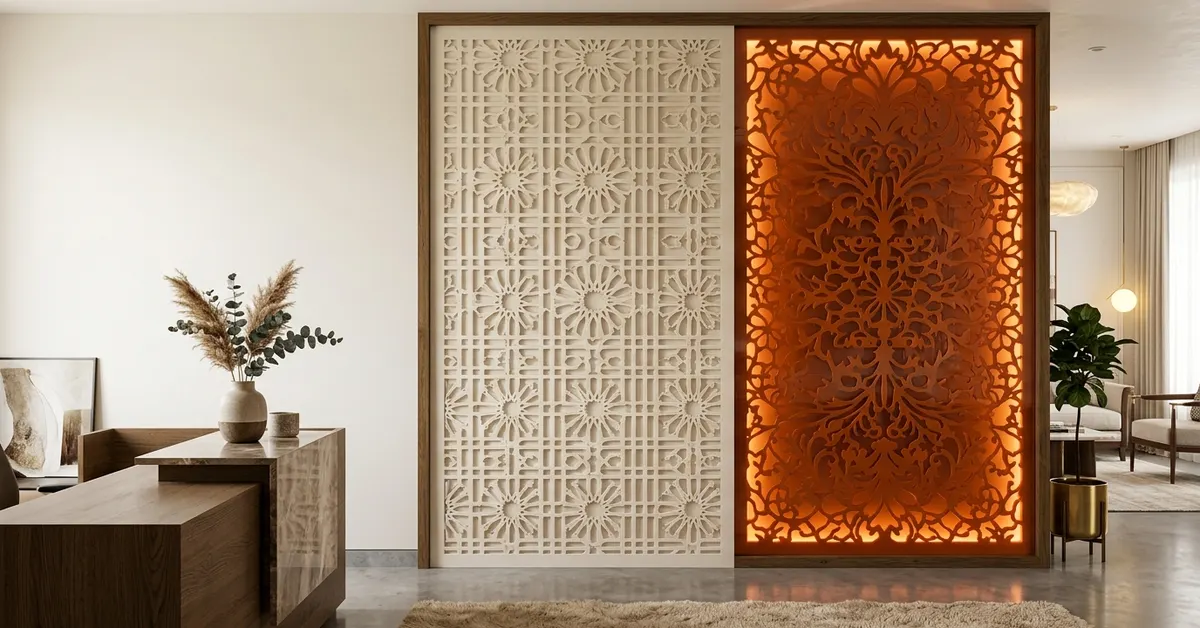
A client once brought us a beautiful floral pattern and asked a simple question: should we cut it in MDF or in acrylic? We asked where it was going. A mandir wall, he said, with a light behind it. That one detail changed everything. If you are stuck on the same choice, you are not alone. The decision between MDF vs Acrylic looks small on paper, but it affects cost, finish, lighting and how long the piece lasts. Our CNC cutting MDF services in Indore team handles this question almost daily.
Here is the short version. MDF is the better pick for thick panels, carved jali and painted furniture. Acrylic is the better pick for light, shine and water. Both are covered in detail below, along with a comparison table, cost notes and a hybrid method we use at our acrylic laser cutting service in Indore for luxury interiors.
Every point comes from jobs we have cut on our machines, not from a brochure.
MDF vs Acrylic: Which Material Is Better for CNC Cutting and Interior Design?
MDF is better for thick structural panels, deep carving, painted jali and cabinet doors at a lower cost. Acrylic is better for backlit signage, illuminated mandir backdrops and wet areas, with a polished glass like edge straight off the laser. Many projects use both.
Comparing MDF and acrylic shows real differences in structure, cutting method, transparency and how each one handles its environment. MDF is an engineered wood composite, cut by a spinning router bit. Acrylic is a synthetic thermoplastic sheet, usually cut by a CO2 laser. Different machines, different results, and different strengths inside a home or office.
So the honest answer depends on three questions. Does light need to pass through? Will the panel see water or humidity? And how thick and heavy does the piece need to be? Answer those and the choice usually makes itself.
What Is MDF and How Is It Cut?
MDF stands for Medium Density Fibreboard. It is made from wood fibres and resin pressed into a dense, grain free sheet. A CNC router cuts it with a mechanical bit, leaving a smooth matte surface that suits paint, PU finish, veneer and 3D relief carving.
MDF is opaque and uniform. A router bit meets the same material everywhere, so it can carve fine slots, textured wall panels and deep relief without tearing. That makes it the base for most decorative jali, wave panels and carved cabinet doors. If you want to see what is possible, our guide to MDF CNC cutting designs shows more than twenty ideas.
The weak point is water. Raw MDF drinks moisture from the air and from splashes, then swells. It works well only when the board density is chosen properly and every face and routed edge is sealed with primer and paint.
What Is Acrylic and How Is It Cut?
Acrylic is a clear or coloured plastic sheet, also called PMMA or perspex. A CO2 laser cuts it by melting and vaporising the polymer along the cut line, which leaves a polished, glass like edge without flame polishing or mechanical deburring.
Where MDF is matte and warm, acrylic is bright and sharp. It comes in clear, frosted, mirror and a wide range of vivid colours, and light travels through it cleanly. Because the laser melts the edge as it cuts, the result is smooth and shiny straight off the machine. No sanding. No buffing.
Acrylic also handles weather well, resists many chemicals and does not absorb water at all. Our guide on what is acrylic sheet used for lists the full range of applications for homes and businesses.
Cutting Method and Edge Quality Compared
MDF is cut by a CNC router and needs light sanding before paint. Acrylic is cut by a CO2 laser and needs no finishing on the edge. MDF handles thick boards and 3D depth, while laser cut acrylic gives finer detail on thinner sheets.
This is where the two materials feel most different on the shop floor. A router bit removes MDF in chips and dust. We use calibrated spindle speeds and good dust extraction, and the edges come off clean and ready for primer after a light sand. Depth is no problem, so 18mm board and 3D carving are routine.
Acrylic behaves in the opposite way. The laser beam is thin, so tiny details and sharp inner corners are possible. Thin sheets in 3mm to 6mm work best. Thicker acrylic can be cut, but the beam slows and the cost climbs. Because there is no contact, nothing chips or tears.
Both machines hold tolerances of about ±0.1mm at our workshop in Indore.
MDF vs Acrylic Comparison Table
Here is a side by side view across the factors that matter most for interior projects:
| Factor | MDF | Acrylic | Better Choice |
|---|---|---|---|
| Cutting method | CNC router bit | CO2 laser | Depends on design |
| Edge finish | Matte, needs light sanding | Polished, glass like | Acrylic |
| 3D relief carving | Excellent | Limited | MDF |
| Light transmission | Opaque | High clarity | Acrylic |
| Water resistance | Poor unless sealed | Waterproof | Acrylic |
| Paint and finish options | Takes any paint, PU or veneer | Colour built in | MDF |
| Material cost | Low | Higher | MDF |
| Thick structural panels | Up to 25mm easily | Costly beyond 8mm | MDF |
| Weather and chemical resistance | Low | High | Acrylic |
Looks, Light and Style: Where Acrylic Stands Out
Acrylic offers high optical clarity, vivid colours and a reflective, modern look. It is the better material for illuminated signage, backlit mandir backdrops, LED reception desks and display stands.
Light is acrylic's superpower. Put an LED strip behind a laser cut acrylic panel and the whole thing glows evenly. Colours stay rich and the cut edges catch the light like glass. That is why shops, clinics and offices choose it for logos, name boards and reception walls.
MDF cannot do this. It is opaque, so light only escapes through the cutouts. That can look beautiful too, especially with a jali pattern, but it is a different effect. MDF gives you shadow and warmth. Acrylic gives you glow and shine.
If signage is your goal, see our page on acrylic LED signage in Indore for sizes, colours and lighting options.
Moisture, Durability and Maintenance
Acrylic is waterproof, chemical resistant and weather tolerant. MDF is sensitive to direct water unless thoroughly sealed with primer and paint. For bathrooms, balconies and kitchens, acrylic or moisture resistant board is the safer choice.
Water is where MDF loses ground. A jali panel has far more edge than face, and raw edges soak up humidity. Seal every channel with primer and two coats of paint, and it will last for years indoors. Skip that step, and it can swell in the first monsoon.
Acrylic simply ignores water. It can be wiped with a damp cloth, and it will not swell, rot or warp. The trade off is scratches. Acrylic marks more easily than painted MDF, so it needs a soft cloth and some care.
For humid rooms that still need a board with weight, you can step up to HDHMR. Our comparison of MDF vs HDHMR explains where that upgrade is worth it.
Cost: MDF vs Acrylic Price in India
MDF costs much less than acrylic per sheet, so it suits large decorative panels. Acrylic costs more but saves money on finishing, since the edge needs no polish and the colour is built into the sheet.
Sheet prices change by brand, thickness and city, so any number in a blog goes out of date quickly. As a rule, acrylic costs several times more than MDF of the same size. For a big partition or a full wall of carved panels, MDF is usually the sensible budget choice.
But sheet price is only half the story. Painting MDF takes labour, primer and drying time. Acrylic comes coloured and polished. On small, high impact pieces such as name plates, logos and backlit inserts, acrylic often works out the better value. For a fuller view of machining charges, read our CNC cutting price in Indore guide.
Best Uses for Each Material
Use MDF for jali partitions, carved doors, wall panels and furniture. Use acrylic for illuminated signs, backlit backdrops, reception desks and waterproof accents. Use both when you want depth and glow in one piece.
Where MDF Is the Better Choice
- Decorative jali partitions and room dividers, where depth and paint finish matter.
- Carved cabinet doors and wardrobe shutters that need grooves and handles.
- Textured 3D wall panels and acoustic diffuser tiles with varied depth.
- Large ceiling inserts and false ceiling panels where cost and weight matter.
- Thick structural panels and interior joinery that need real body.
Where Acrylic Is the Better Choice
- Illuminated signage, name boards and office logos with edge glow.
- Backlit mandir backdrops where even light and rich colour are the goal.
- LED reception desks, display stands and retail fixtures.
- Waterproof accents in bathrooms, kitchens and shaded balconies.
- Reflective wall decor and modern interior panels with a glossy finish.
For home temples, our acrylic mandir panels in Indore page shows how backlit designs look in real homes.
Hybrid Designs: Combining MDF and Acrylic
Hybrid panels embed laser cut acrylic fretwork inside a routed MDF frame. The result has the warmth and depth of wood with the glow and polish of acrylic, and it suits illuminated ceilings, luxury screens and feature walls.
You do not always have to choose. At Eish CNC Designs in Indore, our craftsmen often combine both materials into one component. A typical example is a routed MDF frame with a laser cut acrylic jali insert fitted behind or inside it. With an LED strip behind the acrylic, you get a soft glow framed by a carved wooden border.
This approach works well for illuminated ceiling panels, luxury interior screens and mandir backdrops. It also lets you spend wisely. The expensive acrylic goes only where the light shows, while the cheaper MDF forms the large frame.
How Eish CNC Designs Cuts MDF and Acrylic in Indore
Eish CNC Designs, at Namak Wali on Dhar Road in Indore, runs CNC routers and CO2 laser cutters with tolerances of ±0.1mm. It offers job work with your own sheets or a complete service with material supply.
We operate advanced CNC routers for MDF and laser cutting machines for acrylic under one roof. That means one team can advise on both materials and build hybrid pieces without sending work between shops. Interior designers, commercial fabricators and homeowners all use the same simple process.
Share your vector design in DXF or CDR format on WhatsApp. We review the file for feasibility, suggest the right material and thickness, and send transparent pricing. If you only have a sketch, our designers can turn it into a machine ready file. Each material choice is matched to the acoustic, structural, lighting and moisture needs of your project across Madhya Pradesh.
You can also read about the file formats we accept on our 2D CNC cutting services page.
Conclusion
So, MDF vs Acrylic: which one should you pick? Choose MDF when you want depth, paint colour, thick panels and a lower budget, as in jali partitions, carved doors and wall panels. Choose acrylic when you want light, shine and waterproofing, as in backlit mandirs, signage and reception desks. And when a project needs both, combine them. Match the material to the room, and the result will last.
Not sure which suits your design? Send us your drawing and a few site details, and we will recommend the right material and quote within 24 hours. Contact Eish CNC Designs and let's plan your project.
Frequently Asked Questions
-
Is MDF or acrylic better for CNC cutting?
Neither wins everywhere. MDF is better for thick panels, deep 3D carving, painted jali and cabinet doors at a lower cost. Acrylic is better for backlit panels, signage and wet areas, because laser cutting leaves a polished, glass like edge and the sheet does not absorb water.
-
Can you CNC cut acrylic with a router?
Yes, acrylic can be routed with the right bit and slow feed, but the edge usually needs polishing. A CO2 laser is the better tool for most acrylic work because it melts the edge as it cuts and leaves a clean, clear finish with no deburring.
-
Is acrylic more expensive than MDF?
Yes. Acrylic sheet usually costs several times more than MDF of the same size and thickness. MDF wins on price for large decorative panels, while acrylic is worth the extra cost when you need transparency, a glossy finish or full waterproofing.
-
Is acrylic waterproof and MDF not?
Acrylic does not absorb water and is safe in bathrooms, kitchens and outdoor shaded areas. Raw MDF absorbs moisture and swells unless every face and routed edge is sealed with primer and paint. Moisture resistant MDF or HDHMR performs better than standard board.
-
Which is better for backlit mandir panels, MDF or acrylic?
Acrylic is better for backlit mandir panels because light passes through it evenly and the colour stays vivid. MDF works well as the carved frame around it. Many home temples combine a routed MDF frame with a laser cut acrylic jali insert.
-
How do I get a quote for MDF or acrylic cutting?
Send your vector design in DXF or CDR format to Eish CNC Designs on WhatsApp. The team reviews feasibility, suggests the right material and thickness, and shares transparent pricing. You can choose job work with your own sheets or a complete service with material supply.