
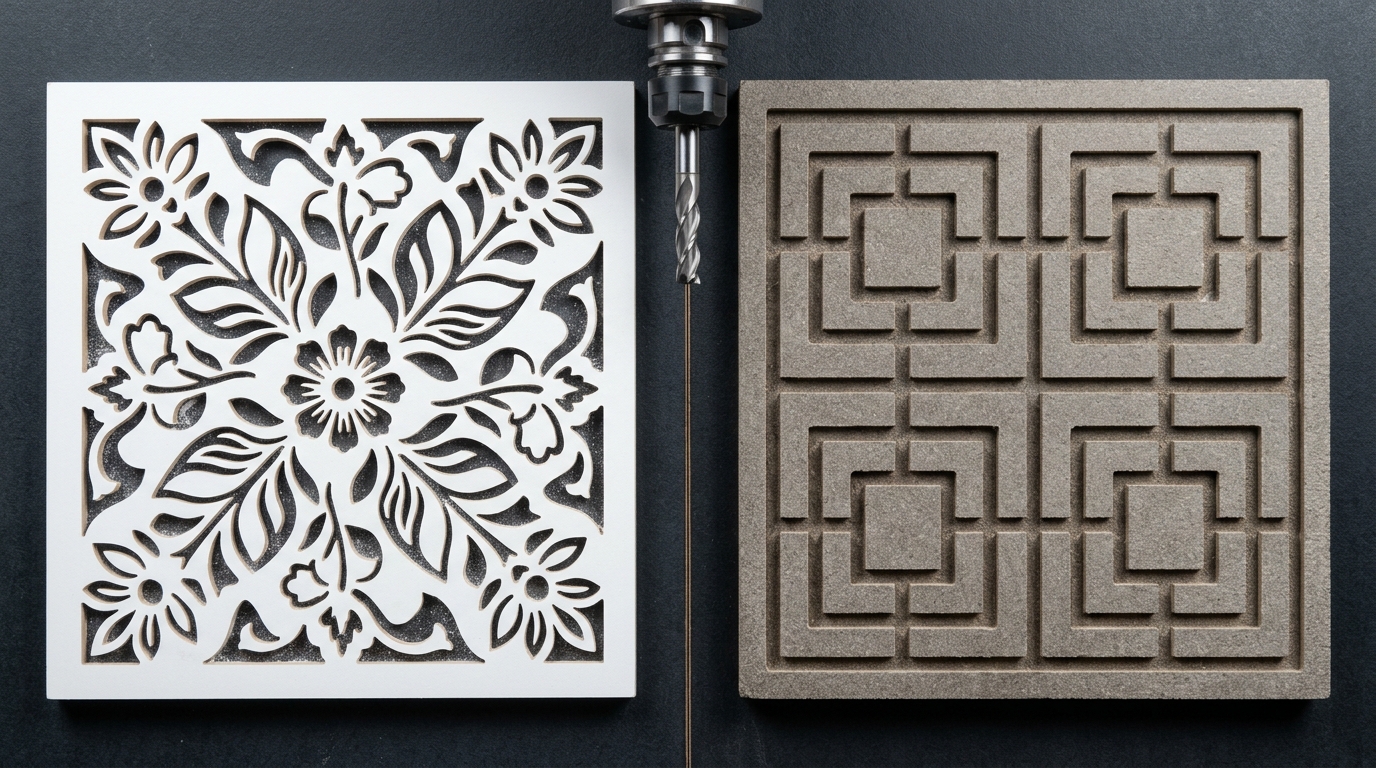
Every few weeks, someone walks into our facility in Indore with the same question. They've done some research, seen the term WPC being promoted heavily by board dealers, and now they're not sure whether to stick with MDF or switch to this newer material. The question makes complete sense. Both are engineered wood products. Both can be CNC cut. Both are used for wall panels, partitions, and decorative elements. But they are not the same thing, and choosing the wrong one for your specific project will cost you, either in money, in quality, or in having to redo the whole job six months later.
Which Is Better MDF or WPC for CNC cutting? That's the question we get almost every week at our facility in Indore. The honest answer is: it depends on where the panel is going and what you need it to do. This guide breaks down exactly how each material behaves under a CNC router, where each one is genuinely better, and how to make the right call for your project in India.
At Eish CNC Designs, we work with both materials regularly. We've cut intricate jali panels in 6mm MDF and robust outdoor screens in WPC. The comparison below comes from that direct experience, not from a brochure.
What Is MDF and What Is WPC?
MDF is a wood-fibre composite with no grain. WPC is a blend of wood fibre and plastic polymers. That single difference in composition drives every other performance difference between the two materials under CNC routing conditions.
MDF stands for Medium Density Fibreboard. It is made by breaking down wood into individual fibres, mixing those fibres with resin binders, and compressing the mixture under high heat and pressure into sheets. The result is an extremely uniform, grain-free material that behaves identically in every direction when a router bit passes through it. That uniformity is exactly why CNC machinists prefer it for decorative work.
WPC stands for Wood Plastic Composite. The manufacturing process is broadly similar, but instead of using only wood fibre and resin, WPC includes a significant proportion of plastic polymers, usually PVC or polyethylene. The plastic is what gives WPC its water resistance. It also changes how the material behaves during machining, finishing, and daily use in ways that matter quite a lot when you're choosing between the two for a CNC project.
Both come in standard sheet sizes and a range of thicknesses from 6mm to 25mm, which makes them direct substitutes on paper. In practice, they are quite different to work with.
CNC Cutting Performance: MDF vs WPC
MDF is the superior material for fine CNC work. It produces cleaner cut edges, handles intricate patterns without chipping or melting, and does not blunt router bits as quickly as WPC. For jali designs, 3D relief carving, and detailed decorative work, MDF is the correct choice.
Here's where the difference really shows up. When our CNC router cuts through MDF, the bit passes through a consistent, homogeneous material. The result is a clean, smooth edge on every cut, whether it's a 3mm slot in a geometric pattern or a 0.8mm detail in a floral jali. The edges come off the machine ready for light sanding and primer. No melting, no tearing, no plastic smell.
WPC tells a different story. The plastic content in WPC generates heat when the router bit moves through it quickly. On simple cuts, this is not a problem. But on tight radius curves, intricate patterns, and repeated passes for 3D relief carving, that heat can cause the material to partially melt at the edge. The result is a slightly rough, uneven edge finish that requires significantly more sanding before the panel is ready for paint. For simple geometric panels with large cutouts, WPC performs adequately. For complex jali work, the extra post-processing time adds labour cost and can still leave the edges visually inferior to MDF.
Router bit wear is also noticeably faster on WPC. The plastic-abrasive combination dulls carbide bits faster than wood fibre alone. Over a commercial production run of 20 to 30 panels, the bit replacement cost difference becomes real money. Our CNC cutting MDF services are specifically optimised for the feed rates, spindle speeds, and bit geometries that produce the cleanest possible result on MDF.
Moisture Resistance: Where WPC Wins Clearly
Standard MDF swells and crumbles when exposed to sustained moisture. WPC does not. For outdoor panels, bathroom screens, balcony partitions, or any installation in a non-air-conditioned space that sees regular humidity, WPC is the practical choice.
This is the main selling point of WPC, and it is a legitimate one. Standard MDF is sensitive to water. A panel installed near a bathroom door that gets regular steam exposure, or on a balcony in a region with heavy monsoon humidity, will begin to swell at the edges within a season. Once MDF swells, the paint film cracks, the fibres separate, and the panel cannot be repaired. It has to be replaced entirely.
WPC doesn't swell. The plastic polymer matrix seals the wood fibres against moisture absorption. You can install WPC panels in semi-outdoor pergolas, near swimming pools, in laundry areas, and in commercial kitchens where regular cleaning with wet cloths is standard practice. None of those applications would be appropriate for standard MDF.
That said, there is a middle option that many projects don't consider. HDHMR, or High Density High Moisture Resistance board, sits between standard MDF and WPC. It is denser than MDF, significantly more moisture resistant, and much better suited to CNC routing than WPC. Our MDF vs HDHMR guide covers the specific performance data if your project sits in that grey zone between a fully dry interior and a truly wet environment.
MDF vs WPC: Full Comparison Table for CNC Projects
Here's a direct side-by-side breakdown across every factor that matters for a CNC cutting project in India:
| Factor | MDF | WPC | Winner |
|---|---|---|---|
| CNC edge quality on intricate patterns | Excellent, clean sharp edges | Fair, slight melting on tight curves | MDF |
| Moisture resistance | Poor (standard MDF) | Excellent, does not swell | WPC |
| Paint and PU finish adhesion | Excellent, absorbs primer well | Fair, requires adhesion primer | MDF |
| Cost per sheet (12mm standard size) | ₹600 to ₹900 | ₹950 to ₹1,500 | MDF |
| Router bit wear rate | Low, gentle on carbide bits | Moderate to high | MDF |
| Weight at same thickness | Moderate | Heavier | MDF |
| Outdoor and semi-outdoor suitability | Not suitable | Suitable | WPC |
| 3D relief carving capability | Excellent, consistent depth | Limited, heat buildup on deep passes | MDF |
| Availability in India | Widely available | Available but fewer brands | MDF |
| Veneer and laminate application | Excellent, bonds perfectly | Good, requires surface prep | MDF |
Paint and Finish Quality: MDF Takes This Category
MDF accepts PU paint, Duco, veneer, and laminates better than WPC does. The porous wood-fibre surface of MDF bonds with primer at a molecular level. WPC's plastic content creates a surface that paint can sit on but doesn't grip the same way without adhesion primer.
For most decorative interior projects, the finish quality is just as important as the CNC cut quality. A jali panel that has rough edges and patchy paint is not going to impress anyone, no matter how elegant the pattern was on screen.
MDF finishing is well understood by every painter and fabricator in India. You apply two coats of primer, sand between coats, and then spray PU or Duco for a hard, smooth finish. The result is reliably consistent. Veneer bonds to MDF with standard contact adhesive and holds without bubbling or peeling under normal indoor conditions.
WPC requires a different approach. The plastic-rich surface doesn't absorb primer the way MDF does. You need either a dedicated adhesion primer or mechanical key, meaning scuff sanding to 120 grit, before the topcoat will bond properly. Veneer application on WPC is also less reliable, particularly at the edges near CNC cuts where the wood-plastic interface is exposed. Several clients who have tried to veneer WPC panels have reported delamination at cut edges after six to twelve months. On properly primed MDF, that problem simply doesn't happen.
If you're curious about how MDF compares to another common substrate for painted interior panels, our MDF vs plywood CNC carving guide covers that comparison in practical detail.
Cost Difference and Project Economics
A standard 12mm MDF sheet in Indore costs roughly ₹600 to ₹900. An equivalent WPC sheet of the same size runs ₹950 to ₹1,500, depending on the brand and density. For a project using 20 sheets, that cost difference is ₹7,000 to ₹12,000 in materials alone, before CNC time and finishing are factored in.
The cost gap matters, but it needs to be read carefully. If you're fitting out a dry, air-conditioned office or living room, paying the WPC premium is hard to justify. The moisture resistance you're paying for simply isn't needed in that environment, and the inferior CNC routing and paint adhesion actually make the final product look worse for more money spent.
On the other hand, if you're doing an outdoor pergola, a bathroom accent wall, or a garden partition that will face Indore's monsoon season without protection, spending the extra amount on WPC is the rational choice. The alternative is replacing a warped, paint-peeling MDF panel within two years, which costs more than the WPC premium would have cost upfront.
There is also WR-grade MDF, specifically manufactured with moisture-resistant resin. WR MDF costs roughly 15 to 20 percent more than standard MDF but significantly less than WPC, and it performs acceptably in moderately humid environments. It's a practical middle-ground for semi-outdoor spaces where full WPC is overkill and standard MDF is inadequate. For a detailed breakdown of material and machining costs in Indore, see our CNC cutting price guide.
Application Guide: Which Material for Which Project
Use MDF for all interior decorative CNC work where finish quality and design complexity matter. Use WPC for outdoor, wet-area, or high-humidity applications where the panel faces sustained moisture. Use HDHMR for projects that sit between those two conditions.
Living room feature walls and TV unit backdrops: MDF. The design complexity, paint finish quality, and cost all favour MDF for purely decorative interior panels. Our MDF jali design for living room guide covers patterns, thicknesses, and finishing options in detail.
Office reception panels and cabin partitions: MDF for standard air-conditioned offices. The brand statement you can achieve with a precision CNC-cut logo panel in 18mm MDF cannot be replicated in WPC at the same cost and quality level.
False ceiling jali panels: MDF, specifically 8mm to 12mm for framed ceiling applications. The weight saving over WPC matters at ceiling level, and the ceiling environment is dry by definition. Our MDF jali design for ceiling guide covers structural requirements and LED backlighting integration.
Bathroom accent walls or screens: WPC or HDHMR. Steam exposure in an Indian bathroom is sustained enough that standard MDF will fail within a season.
Balcony and semi-outdoor partitions: WPC for balconies that face direct rain. If the balcony is covered and only faces occasional humidity, HDHMR is a cost-effective option.
Outdoor garden screens and pergola panels: WPC only. Standard MDF has no place outdoors in any Indian climate.
Our full range of CNC MDF cutting services works with all of these material grades. If you're unsure which board is right for your project, our team will recommend the appropriate grade before the order is confirmed. You can also see how CNC cutting is applied to wood-based materials in our CNC on wood service page for solid wood comparisons alongside MDF.
Conclusion
Which Is Better MDF or WPC for CNC cutting work in India? For every interior application in a dry or air-conditioned environment, MDF wins. Better edge quality, superior paint adhesion, lower cost, lighter weight. WPC is the right call only when sustained moisture is genuinely part of the installation condition. Outdoor screens, bathrooms, balconies exposed to the monsoon. For everything else, WPC is a more expensive material that produces a visually inferior result. At Eish CNC Designs, we'll help you choose the right board for your specific project and get you a quote within 24 hours. Contact our team with your site conditions and design brief and we'll take it from there.
Frequently Asked Questions
-
Which is better, MDF or WPC, for CNC cutting?
For CNC cutting, MDF is better for intricate designs, jali patterns, 3D relief carving, and any project that needs a painted or veneered finish. WPC is better for outdoor or high-humidity applications where moisture resistance matters more than design complexity. For most Indian interior projects, MDF is the preferred material.
-
Can WPC be CNC cut like MDF?
Yes, WPC can be CNC cut, but it behaves differently from MDF. WPC has a plastic component that generates heat during cutting, which can cause melting or rough edges on intricate patterns. MDF, being a pure wood-fibre composite with no plastic, routes cleanly at all speeds and produces sharper, finer detail.
-
Is WPC more expensive than MDF in India?
Yes. WPC boards in India typically cost 30 to 60 percent more per sheet than standard MDF of the same thickness. For moisture-prone areas where WPC is genuinely needed, the premium is justified. For interior applications in air-conditioned spaces, standard MDF or HDHMR offer better value.
-
Which material is better for bathroom or kitchen CNC panels?
For bathrooms and kitchens where water splashing is a regular concern, WPC or HDHMR are safer choices than standard MDF. Standard MDF swells permanently when it absorbs water. WPC does not swell at all. However, for kitchen cabinet doors that are painted and sealed, BWR-grade MDF or HDHMR can perform adequately.
-
Which material holds paint better, MDF or WPC?
MDF holds paint significantly better than WPC. The wood-fibre surface of MDF is highly receptive to primer and topcoats. PU paint, Duco, and veneer all adhere extremely well to primed MDF. WPC's plastic content creates a less porous surface that requires sanding and adhesion-promoting primer before paint will bond reliably.
-
What is the biggest disadvantage of MDF compared to WPC?
MDF's biggest disadvantage is moisture sensitivity. Standard MDF swells when exposed to sustained moisture, which can cause the paint film to crack and the board edges to crumble. This makes it unsuitable for outdoor use or areas with poor weatherproofing. WPC does not share this weakness.
-
Which board is better for CNC jali wall panels in India?
For interior CNC jali wall panels, MDF is the clear choice. It produces cleaner cut edges, handles intricate patterns without chipping, accepts paint beautifully, and costs significantly less than WPC. For outdoor or semi-outdoor jali screens, WPC is the better option due to its weather resistance.